KINK & BDSM
The Political Risk of Denying Eros
When the White House posted a Daddy kink meme, one writer confronted her own submission desires — and found a political case for trusting erotic longing.
When the White House posted a Daddy kink meme, one writer confronted her own submission desires — and found a political case for trusting erotic longing.

Photo by Tara Winstead on Pexels
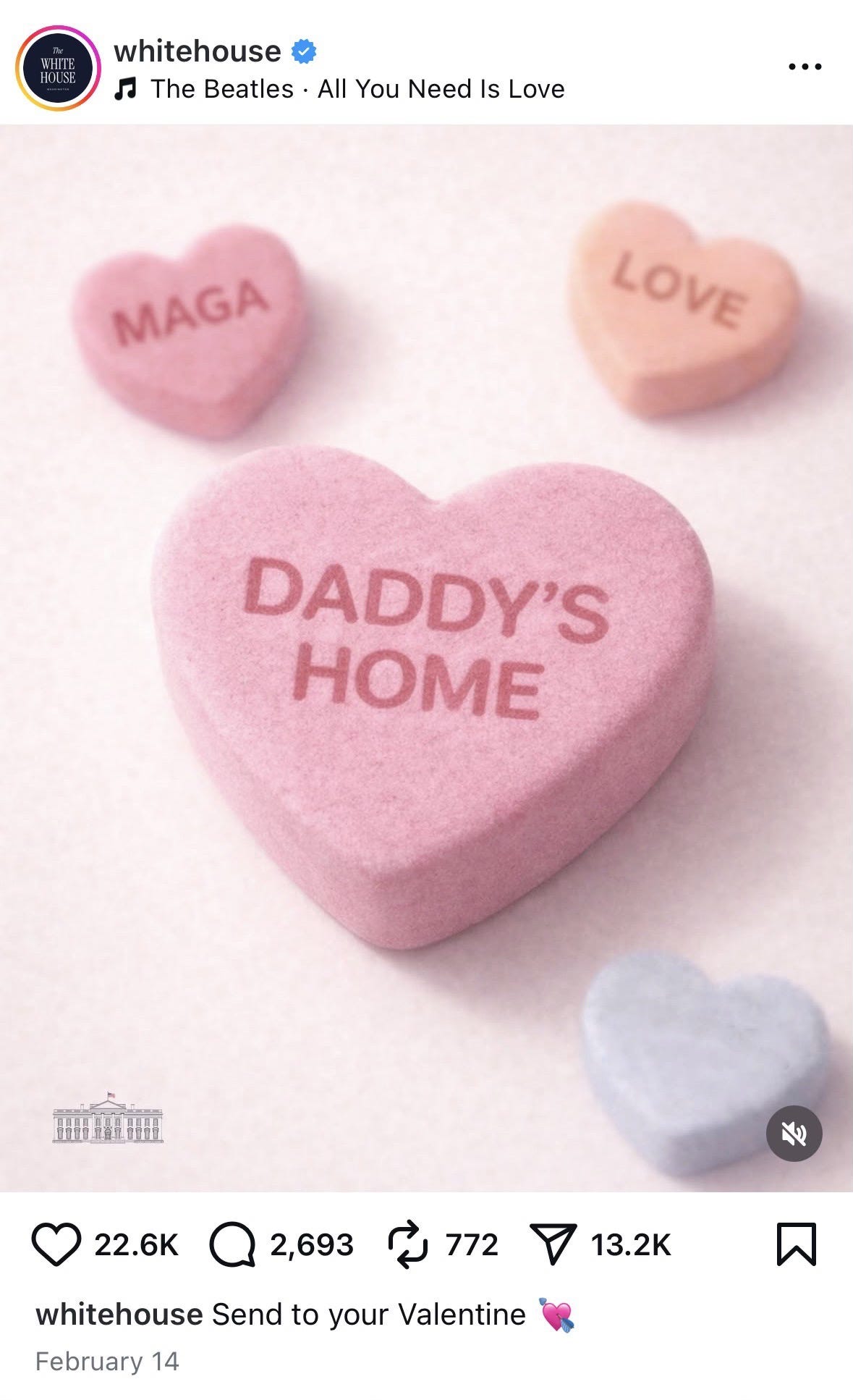
This past Valentine’s Day, the White House Instagram account posted a photo of three candy hearts. The two smaller hearts at the top said “MAGA” and “LOVE.” The largest heart, centered and in focus, said “DADDY’S HOME.”
[
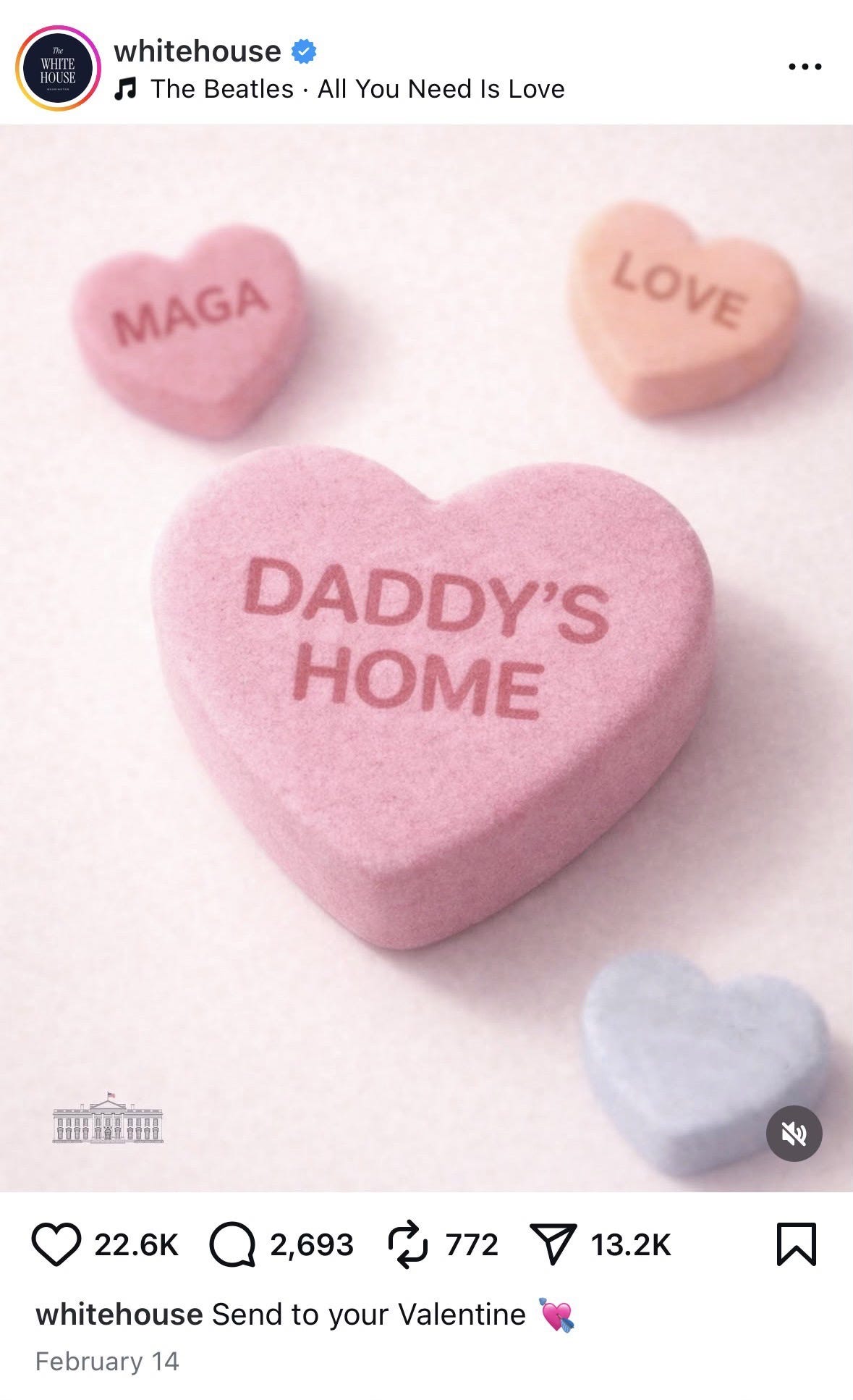
I immediately took a screenshot and sent it to my partner Don, with a two-word text: “Complicated feelings.” Don and I have had a Daddy-little girl kink dynamic for almost three years—something I asked for explicitly. When we met, I didn’t really know what love meant to me, but I knew that I was attracted to paternalism in men.
I don’t have complicated feelings about my relationship with Don. The ways he supports me emotionally, financially, and logistically have allowed me to thrive in ways I never thought possible. But the White House’s explicit deployment of Daddy politics did bring up a familiar worry: was my eroticization of the powerful father figure part of the fuel that was allowing fascist politics to thrive?
Since Wilhelm Reich published The Mass Psychology of Fascism in 1933—a book that describes fascism as an ideology with a uniquely libidinal quality—many thinkers have viewed the relationship between dictators and their adoring masses through a gendered, sexual lens. As Laura Frost describes it, many see fascist politics as a “sadomasochistic encounter between a male leader and the collectively feminized masses.”
Fascist movements have always operated on spectacle. Think uniforms that harden and sculpt, synchronized marching and mass rallies, chants that collapse the distance between leader and crowd, simple physical gestures of allegiance. They make hierarchy feel intimate. Put another way, fascists understand how to unleash erotic energy to amass power.
When I was twenty and a student in Hong Kong, I traveled to North Korea as part of a tightly controlled tour group. On a bright, almost aggressively clear day, we were taken to the towering bronze statues of Kim Il Sung and Kim Jong Il and instructed to bow—a ritual rooted in decades of North Korean state propaganda that casts both men as not only political leaders but also as fathers of the nation.
The women visiting the monument wore traditional dress: jeogori jackets fitted tightly at the chest, long chima skirts flaring down to the ground. Two of them wore Barbie pink, trimmed with satin ribbon and tulle. They wept as they bowed. As their bodies folded forward in synchronized reverence, I saw that their faces were streaked with tears. I knew the regime they were bowing to was violent and coercive, and that no one was allowed to refuse to bow.
But as I watched them, something shameful moved inside me.
I did not want to bow to those men. But I did want to bow. I wanted to feel what it would be like to surrender to something vast and unquestioned, to lay down the burden of discernment and simply fold myself into obedience. I wanted the spiritual clarity of kneeling before a power that felt larger, wiser, steadier than myself. It was scary—feeling in myself the very emotional, libidinal charge that fascists exploit for their own gain.
Before I met Don, I spent many years chastising myself for clinging to the white knight fantasy. I felt convinced that the longings I had for a strong man to take care of me were not only individually dangerous, but societally dangerous—that my submissive fantasies were fuel for oppressive political structures. And so I did what I was supposed to do—I supported myself financially and I accepted that romantic relationships with men were only safe if they were symmetrical. And only if I didn’t depend on them.
But I was exhausted. My job was demanding, I was a single mom, and I just wanted someone to take care of me and tell me what to do. I wanted to end each day nestled under the strong arm of a big man. Right-wing politics offered a simple answer to this longing. It is natural. It is feminine. It is your path to safety. Submit to the right man and you will be protected. Left-wing politics offered another answer. It isn’t your fault that you feel this way, but it is dangerous. Your body still hasn’t shed its internalized patriarchy and it is on you to analyze, unpack and ultimately exorcize it. When you do, you will develop less dangerous desires.
On an individual level, I felt that there was something wrong with me. That until I healed from my childish, codependent fantasies of rescue, I would be unhappy, and I wouldn’t be able to know real love.
The only spaces I found in my progressive, New York City circles that treated my yearning for submission as worthy of exploration were kink spaces. I got the message that it was ok to indulge in submission as long as it was contained in compartmentalized roleplay. Basically, I told myself, as long as I remained self-sufficient, independent, and emotionally self-regulating in my “real” life, my pathological desire wouldn’t metastasize into something politically dangerous.
But those scenes, while often pleasurable, exciting, and novel, ultimately felt hollow. And I resented the fact that I was still internalizing the message that the fullness of my longing was dangerous. Letting a man dominate you during sex is fine, calling him Daddy is fine—but be careful that you don’t get sucked down the trad wife rabbit hole. Don’t actually depend on him for anything.
It is true that dependence makes you vulnerable. And for many women, submission is purely utilitarian—a practical response to oppression, stripped of erotic charge. I certainly do not subscribe to the Freudian idea that female sexuality is inherently masochistic, that women are wired to eroticize their own subordination. But I also don’t fully recognize myself in feminist critiques that say we eroticize powerlessness only because patriarchy trains us to. I think submission can also be engaging something deeper than patriarchy—our existential powerlessness. Because even in a utopia without patriarchy, the human condition is ultimately one of powerlessness against our own mortality.
The more I interrogated my longing, the clearer it became that there was an uncorrupted eros in my attraction to dependence and paternalism—one I didn’t want to quarantine. What my body was reaching toward was not domination, but love that could hold my dependence and my existential powerlessness without exploiting it.
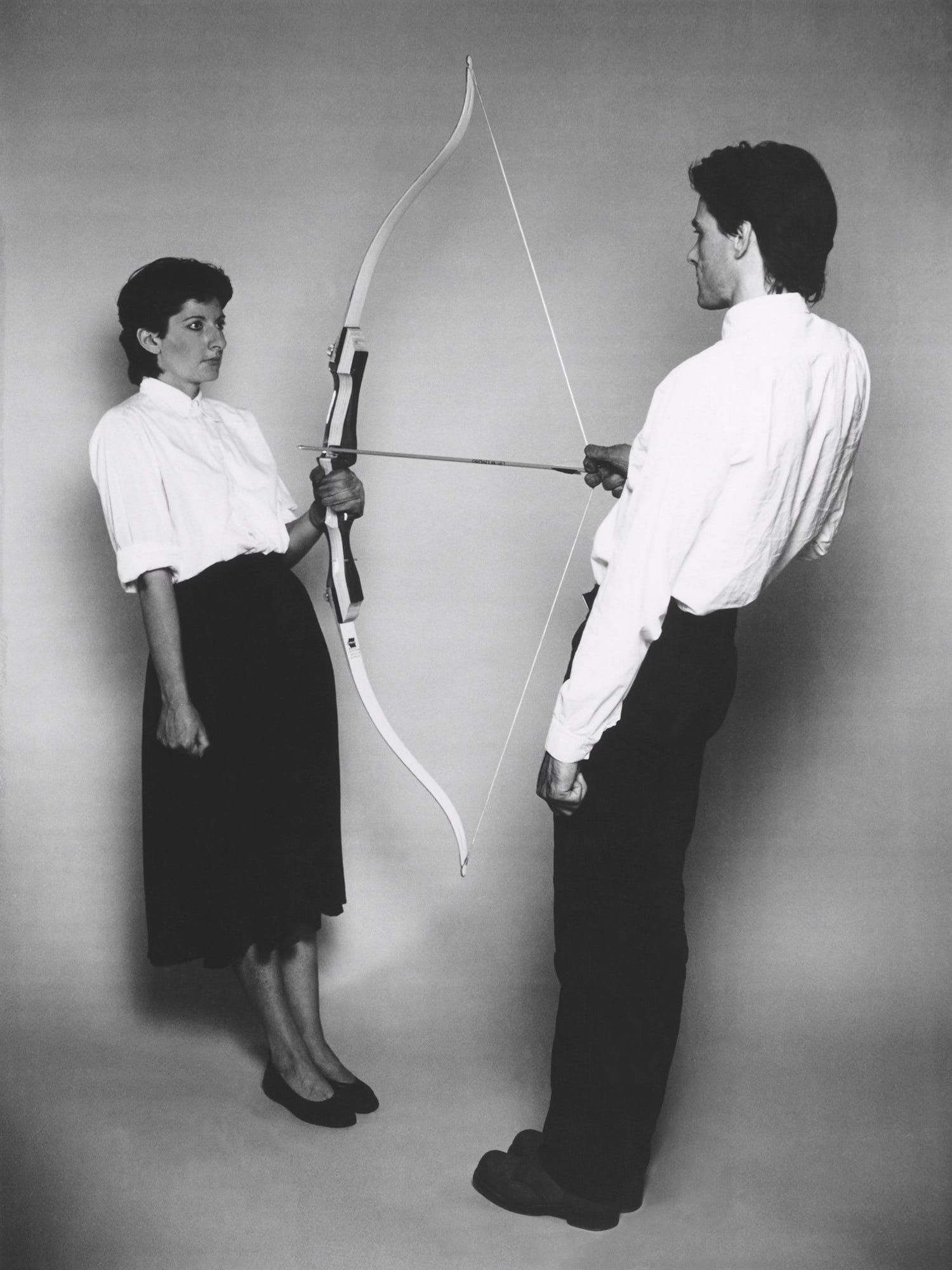
In Rest Energy, performance artists Marina Abramović and Ulay lean apart from one another for four minutes and ten seconds, their weight pulling in opposite directions on a bow, creating the tension needed to potentially release an arrow pointed at Marina’s heart. If either of them let go, Marina dies. The piece makes visceral the power that the people we love have over us. To love is to open yourself up to the possibility of being annihilated. The only antidote, besides a life without love, is trust. Trust transforms that power into vitality.
[
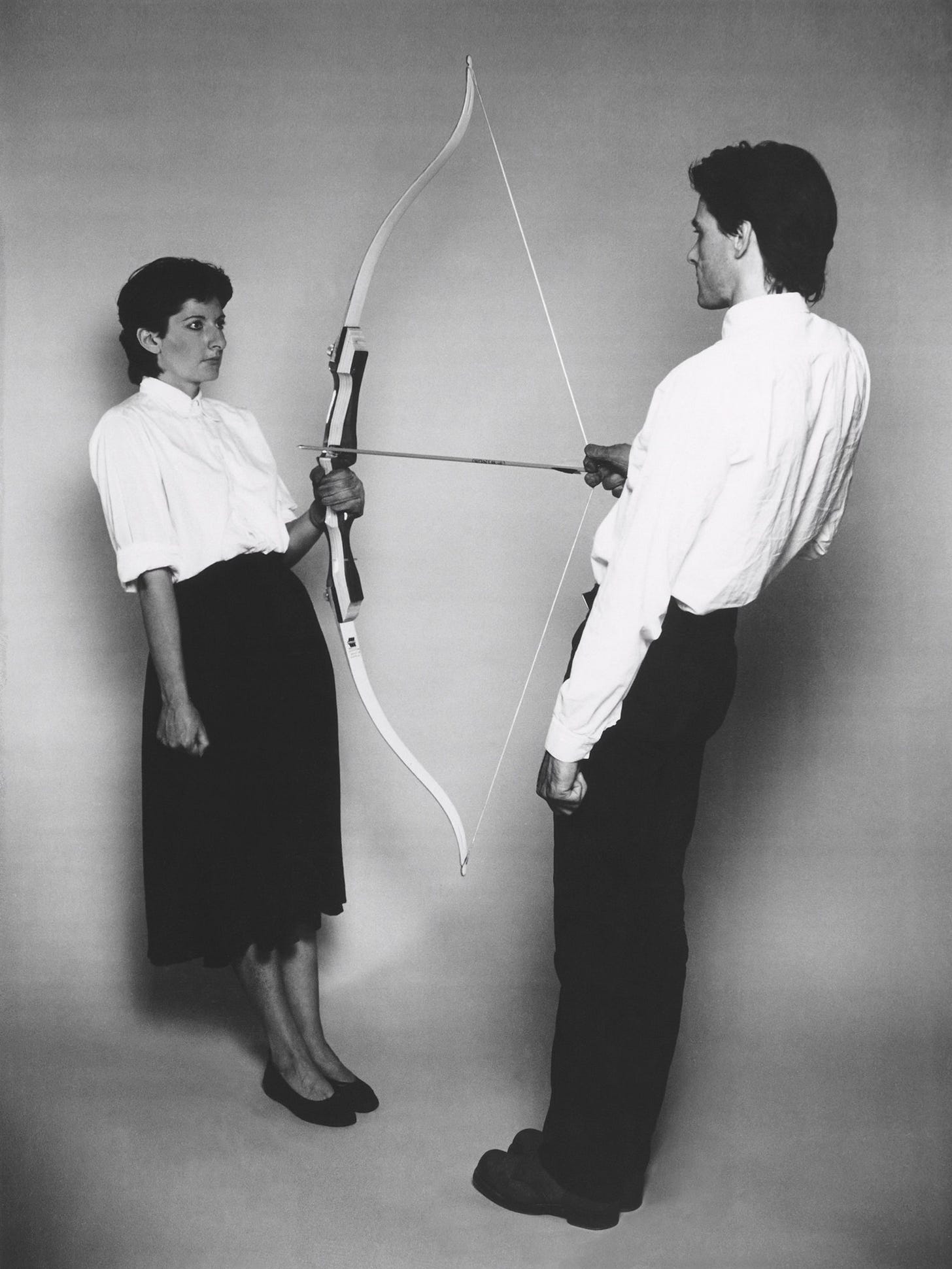
It is frustrating to me that right-wing ideology still feels like the only political place that acknowledges the erotics of asymmetrical human relationships. Because there is a difference between mandated asymmetry, which keeps women powerless in order to extract their sex, labor, and performances of devotion, and asymmetry that is chosen, loving, existentially honest, and a source of vitality.
Left-wing politics has the concept of interdependent solidarity. It is rational and practical—we must work together to achieve collective liberation. This is important. But I want a political home that treats my body’s existential eroticization of dependence and submission as something valuable that contributes to liberation, too. Because I believe that it is. Because love is necessary for liberation and for me, love looks like surrender.
bell hooks wrote:
Loving fatherhood embodies feminist masculinity in its most divine form… we must dare to proclaim our adoration, to bow down not to the male dominator, but to the male as embodied divine spirit with whom we can unite in love, with no threat of separation, knowing a perfect love that is without fear.
Before bed each night, I kneel at Don’s side and tell him what I’ve been thinking about that day. I give him my internal world because I trust him to take it and use it to take care of me. It is a ritual that I asked for.
When I kneel to him, I am not kneeling to male supremacy. I am kneeling to a man who has earned my devotion through consistency, steadiness, and care. Who doesn’t exploit the part of me that continues to feel a charged longing—simultaneously childish and erotic—for paternalistic care. He acknowledges that to love him, I am submitting to giving him the arrow pointed at my heart, and he holds that power benevolently.
I’m still not sure where the erotic energy of my desire for submission belongs in the public political conversation. Obviously not anywhere near a wannabe fascist who calls himself “Daddy.” And I certainly don’t think the solution to late-stage capitalist malaise is for each individual woman to find a strong man to protect her. But I do believe that daring to love, daring to follow our erotic desires, however they manifest, is not politically irrelevant. It is one of the few forces powerful enough to reorganize a life. And if we refuse to acknowledge the power of eros, someone else will be more than happy to weaponize it.
Original Post: Saga McFarland

Scan to download
Comments
Join the conversation — create a free account to comment.
Join the conversationLoading comments…