KINK & BDSM
The Aesthetics of Innocence
Post-Epstein feminism says abandon girlish aesthetics. One woman refuses — arguing her innocence, her desire, and her girlhood still belong to her alone.
Post-Epstein feminism says abandon girlish aesthetics. One woman refuses — arguing her innocence, her desire, and her girlhood still belong to her alone.

Photo by Quentin Martinez on Pexels
Right now, millennial women are grappling with the overwhelming horror that so much of what was sold to us as aspirational in girlhood was shaped by the tastes of a culture that allowed men like Jeffrey Epstein to prosper and thrive.
I remember as a teenager spending hours in front of a specific mirror in my house that was dirty and speckled in a way that made it blurry. It was like a filter that erased pimples and body hair, and I loved seeing myself in it—restored to an unthreatening smoothness that made me feel unsullied and pretty. It was exciting when I first overcame my embarrassment about shaving and made the mirror smoothness a reality.
But something made me not want to tell my mom about it—she didn’t shave her underarms. I could sense that there was a darkness in it and I didn’t want to reveal to her that I was giving myself over to it. But also, I loved feeling the smoothness with my fingers. I liked this version of myself who knew how to restore my body to a state that made it pleasing—yes to compulsory mainstream aesthetics, but also to my own touch.
The Epstein files have provided a stark illumination of the darkness I was sensing. That my ideas of femininity, girlhood and self were being shaped by a culture that told men that it is ok, manly even, to sexualize the aesthetics of childish pliability. Tara Tyrrell voices this horror in her recent essay “The Mass Grooming of Gen Y.” She writes:
I think it’s somewhat easier to cope with one or even a handful of horrible memories of assault than it is to face the truth that our entire girlhoods were shaped by pedophiles.
What do you do, when your abuser isn’t one single person? Your trauma caused not by an event, but an entire cultural period?
Feminist philosopher Kate Manne has written movingly about her own experience of wearing a school girl outfit at the request of a much older man in her younger years and how she is grateful for the disgust she now feels toward anything associated with the male gaze. She writes:
There is a tiny silver lining to this cultural moment that I know I am not alone in experiencing. The aesthetic and sexual standards that long haunted me feel disgusting, all of a sudden. They no longer tempt me. I look at the sexy school girl type I briefly tried to instantiate, when I was nineteen and twenty, and thin enough (for five minutes) to pull off some approximation of this look. And I feel beyond repulsed, not by my own coerced conformity, but by the culture of sexual violence and pedophilic abuse that recommended it to me strenuously. I gaze at the male gaze, and I feel a sense of nauseated contempt. Not trying to look small, smooth-skinned, hairless, and above all young, suddenly got a whole lot easier. Because the thought of even vaguely satisfying the men who would be gratified by such appearances now turns my stomach.
When I read Manne’s words last week, I felt a deep resonance. I remember how freeing and empowering it felt to finally break up with the man who always wanted me to wear sleek black womanly silhouettes and tasteful—but still sexy—heels. I can still feel in my stomach the vague bubbling of awareness as I scoured my closet for something that would suit his tastes and found I only had a hastily purchased funeral skirt and bralette to choose from. I’m changing myself to please him and I don’t know how to stop. It was deeply liberating to eventually metabolize that feeling of self-erasure into a disgust toward him.
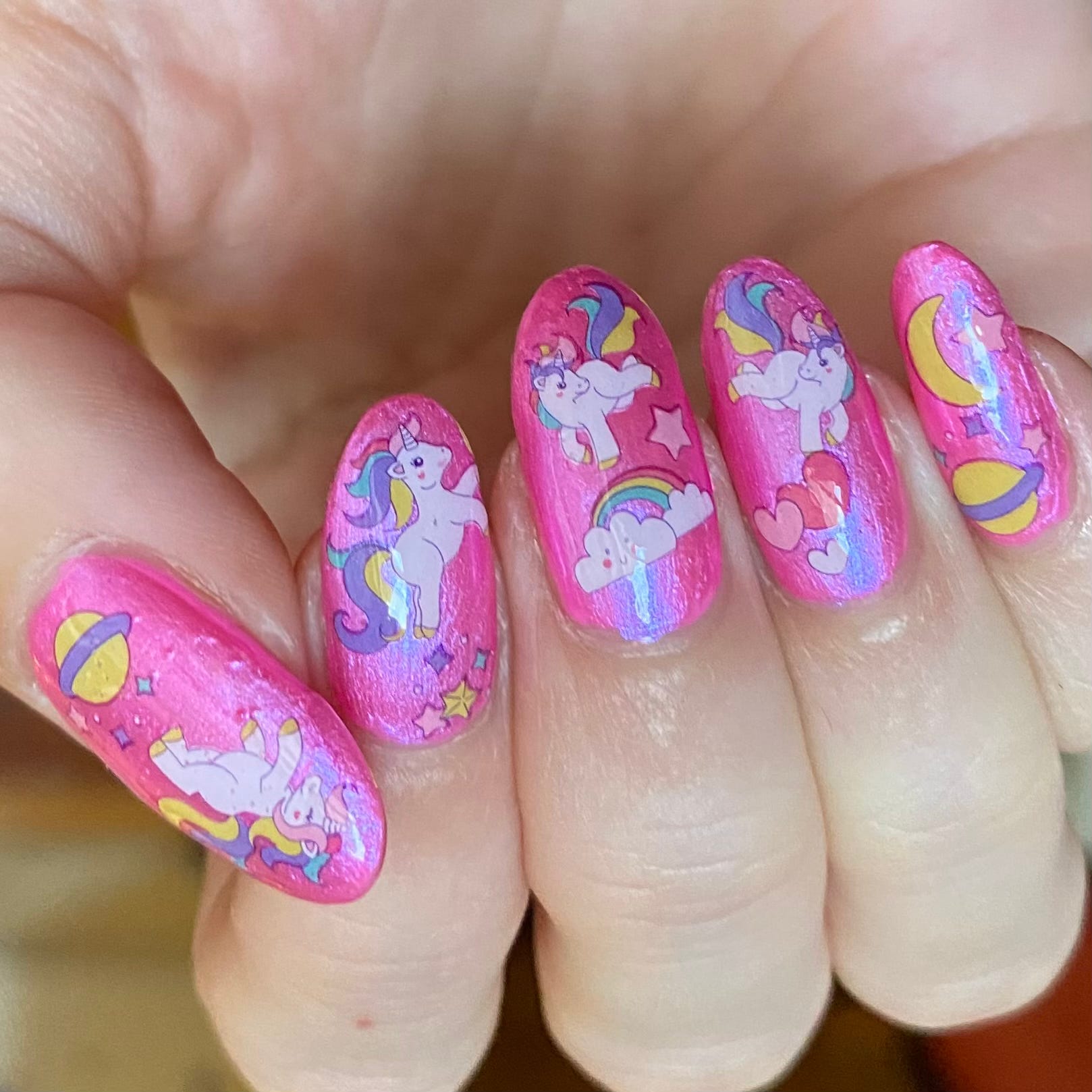
But Manne’s repulsion also made me feel lonely, because I love the aesthetic that she is describing. I love girlish cuteness. I love rubbing my freshly shaved legs together in the shower, when they are smooth and wet like two baby dolphins. I love how thigh-high socks look under a miniskirt. I love painting my nails with cartoon unicorns that remind me of childhood. I love oversized bows. The man who insisted I didn’t dress this way wanted to sleep with me, but he didn’t want to deal with how society might view him with my girlish aesthetic on his arm.
[
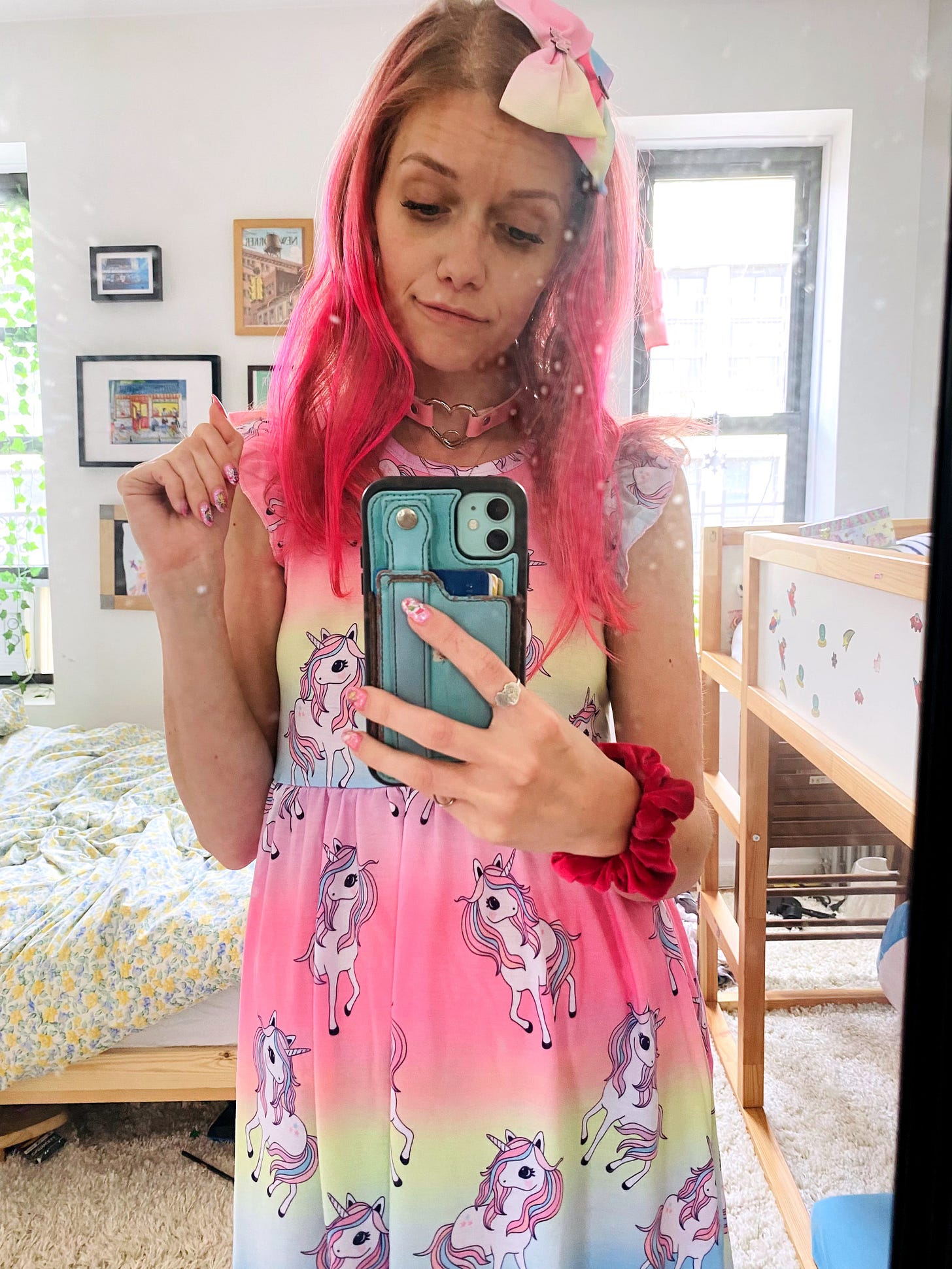
One of my favorite dresses—I love how it has a high waist the way dresses I wore as a girl did. (I’m 31 in this picture)
But right now all of that feels flippant and frivolous. Of course I can see how this aesthetic is entangled with pedophilia, and how generations of girls were groomed into embodying its worst traits—malleability and a desperate hunger for male approval. Why do I feel so attached to the aesthetic joy it brings me? Surely as a good feminist, I can give up my clearly corrupted love of girlish innocence for the sake of the safety of girls and women. For my 10-year-old daughter. What is it that I am holding on to?
And it is worse—I don’t just enjoy embodying this girlish aesthetic. Around age 30, after two kids and a divorce, I admitted to myself that I have a Daddy kink. I don’t think I fully knew what it meant at the time, but it was something about feeling safe and alive in the presence of great power. It was something that I discovered about myself during a two-year period of celibacy and introspection. After a long relationship that began when I was 17, I was trying my best to tune in to what my desire looked like when it wasn’t filtered through the expectations of a man.
I joined a sexuality reflections group with an amazing facilitator. In response to thoughtful prompts, I reflected and wrote. Some of the statements that came out felt like internal truths, others aspirational—how I might feel about myself and my sexuality with enough distance from the near universal shame bequeathed to all women and my own personal sexual trauma. I spent some time rereading those five-year-old excerpts this afternoon:
My sexuality is an integral, non-compartmentalized part of who I am.
I am not troubled or ashamed by the things that turn me on and I am excited to share those things with a partner
I am so proud of myself for valuing my sexuality
Sometimes I still wonder why I’m so turned on by the unrestrained alpha male. Why I want to call men Daddy and delight in being physically overpowered. But I no longer view any sexual preference that emerges from me, including the desire to be dominated by a man, as problematic or at odds with my values.
I am not sure, but I suspect that the physicality of sex is much less important to me than a shared understanding of what we are experiencing together and the dynamics of power, desire and connection between us
I want my erotic self to be seen not as sultry, but as innocent and precious, in need of careful holding
[
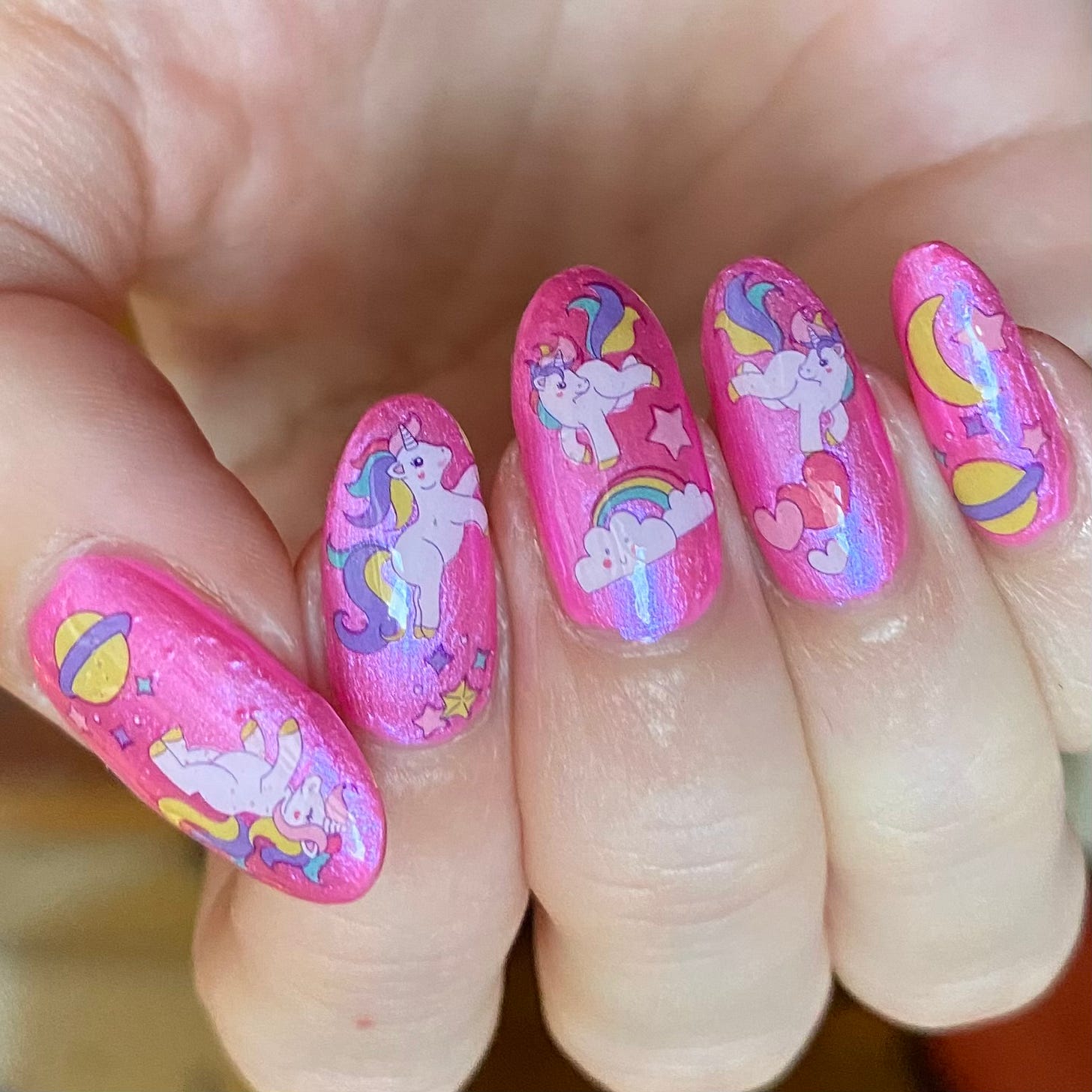
These took me probably like three hours but they lasted for like a month and made me so happy every time I looked down at them.
Reading my past reflections, I felt such tenderness for the young woman who was trying so hard to filter out the world and the culture around her so she could access the innocence of her unpolluted desire.
But Manne seemed to be arguing that the degree of harm associated with the aesthetics and language of my desire was so great that it demanded a forceful disavowal. She writes:
It’s taken for granted in my liberal circles, for instance, that any sexual predilection is valid and no form of kink should be shamed, as long as the way it is played out is safe and fully consensual. As we fall over ourselves to avoid kink-shaming, though, we run the risk of suspending our basic critical faculties. The iconography of “sexy school girls” is demeaning to women and dangerous to girls, normalizing as it does the pedophilic tendencies that are rampant in our culture.
I know what she means—I know she is talking about men imposing this aesthetic on reluctant partners. And yet, I felt so misunderstood. Manne is one of my academic heroes—the way she conceptualized misogyny in Down Girl played a central role in framing my graduate thesis on misogynistic gaslighting as a tool of state power. And I knew she wasn’t targeting me or wanting to make me feel wrong—but I still felt a stinging wounded defensiveness about her claim that the place I found aesthetic and erotic aliveness was demeaning and dangerous.
She seemed to be confirming my worst fear: if this grooming is everywhere and I’ve been receiving it my whole life, then I, too, am tainted. My desire, my aesthetics, my erotic pulse, all of it needed to be scrubbed clean of this influence. But when I try to remove the fingerprints of pedophilia culture, of rape culture, when I try to exorcize myself of its influence, is anything left?
In her essay rebutting the idea that Sabrina Carpenter is indulging the pedophilic fantasy in the way she dresses, Cricket Guest names the impossibility of feminine expression within a culture of pedophilic grooming. She points out, for example, that one of the looks called out for speaking to this fantasy was a pink corset, because it mirrored outfits young girls wore on Toddlers and Tiaras. The feedback loop between girls being encouraged to dress like grown women and women being encouraged to dress like girls is so pervasive, she argues, that all feminine aesthetics end up tainted. She writes:
If I express myself in any type of feminine way I am likely referencing something that is referencing something which in turn references something rooted in this so-called ‘pedophilic fantasy’ — a fantasy that places juvenile feminine beauty on a pedestal.
I don’t dispute that the schoolgirl iconography has its roots in an eroticization of helplessness and innocence. Or that it was elevated by a culture that prioritized the proclivities of men who wanted to access young bodies for their own pleasure, with a sickening disregard for the girls and women those bodies belonged to. But what I do reject is the idea that the group of men who colonized the symbols of girlhood innocence have also stolen from us the possibility of reclamation.
I have my own relationship to my girlhood innocence that they don’t own. I have my own relationship to my memories of feeling unsure and naive about my sexual awakening that these men don’t own—even though they tried to feed on this in me, it is mine. This plane of consciousness, and the aesthetics that help me embody it, belong to me.
[
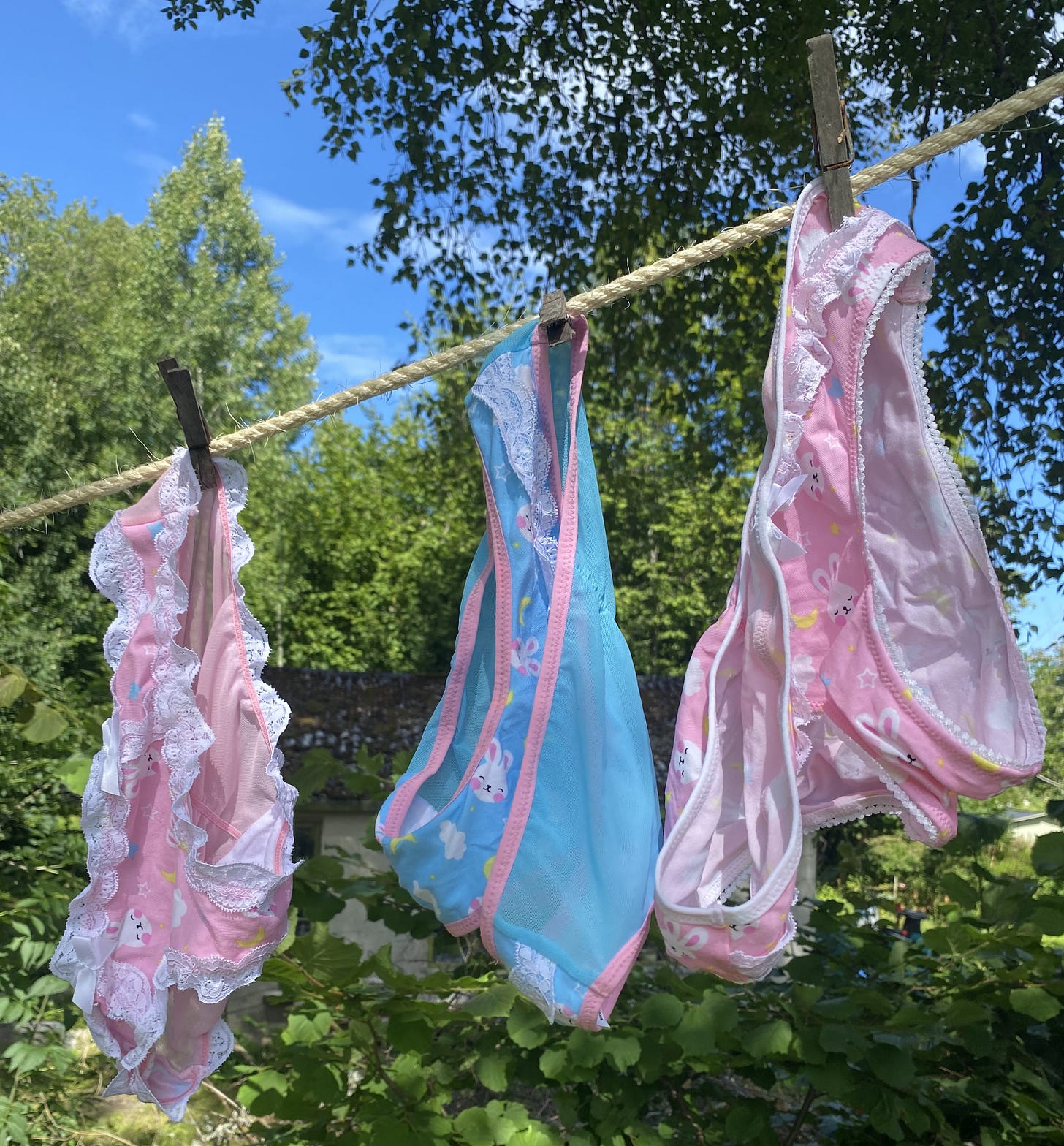
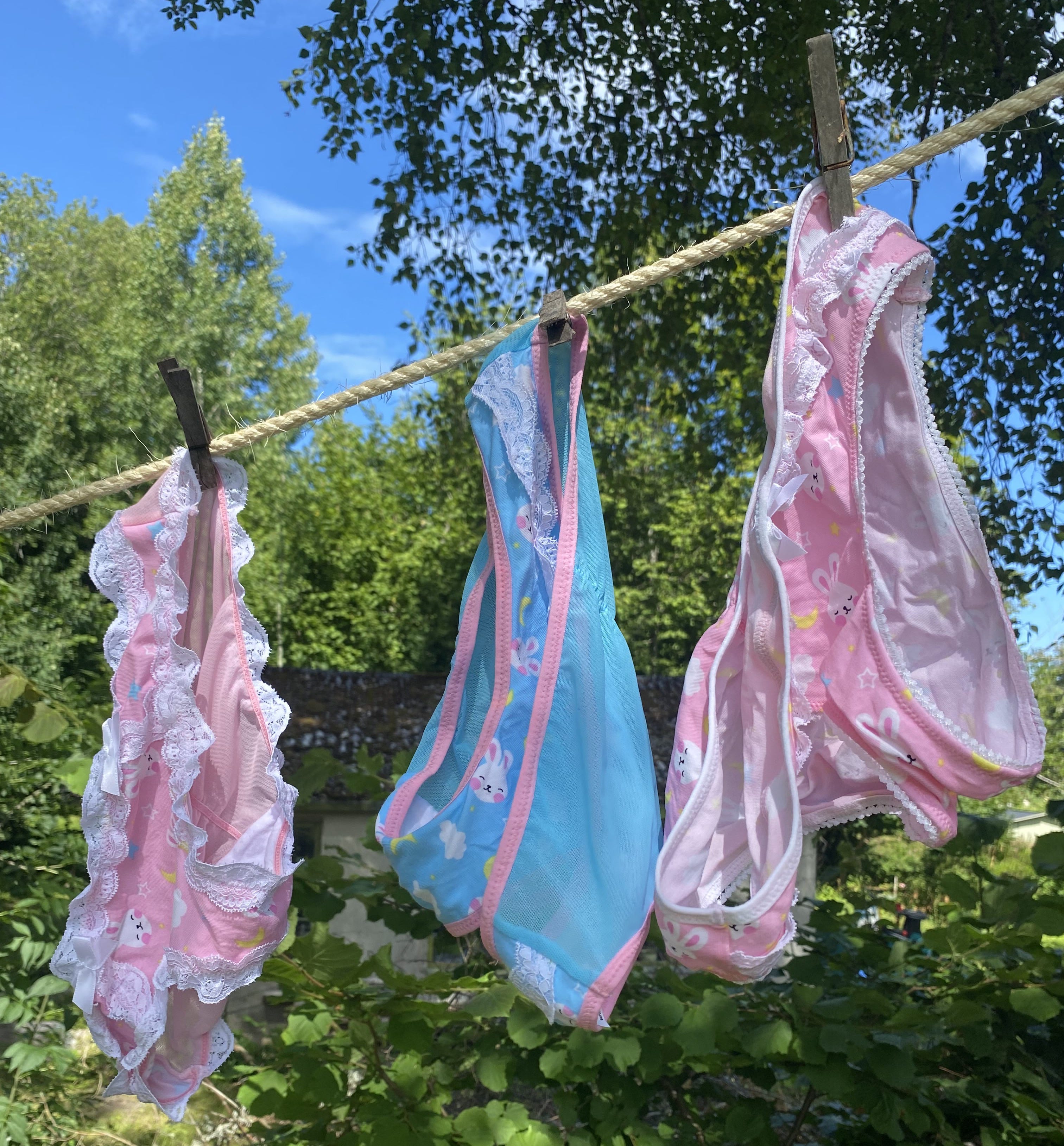
My favorite underwear, hanging to dry in the summer sun.
I don’t want to limit my self-expression by eliminating what gross men like, just because they like it. But more than that, I don’t want to distrust the parts of myself that are drawn to the aesthetics of innocence just because men corrupted them. To me, that feels just like a reproduction of the self-doubt those groomers attempted to cultivate so they could control us.
I do appreciate that Manne points out that within such a corrupted set of norms, relying on consent alone as a measure of whether or not something reproduces misogynistic sexuality may be crude. But I think writing off a specific aesthetic entirely also minimizes the interiority and intention of those who approach its embodiment with an attitude of reclamation.
What I’ve also been trying to hold on to, is that even within the limits of deeply flawed and tainted symbols and language, love flourishes. I can’t help but think about the women who weathered girlhood with me. How we didn’t have body positivity language, or a way to understand that we didn’t need boys thinking we were pretty to be valuable, but we were able to use the imperfect language and aesthetics we were given to make each other feel deeply loved. In the hours we’d spend in the luxuriously carpeted Victoria’s Secret dressing room after middle school we didn’t tell each other that the beauty standards were bullshit—we hadn’t found a way to know that yet—but we found ways to convince each other that we met them, that we belonged.
“That bra looks amazing on you! You literally look like Kate Moss,” we’d say. Or, “Oh my god, that diet is really working, your abs look sooo good!” Or, “how did you get your legs so smooth, can you please show me?”
Even while the culture tried to tell us we were ugly, or prudes, or sluts, we told each other that we were perfect—because we loved each other and we wanted more than anything to make each other feel good.
And I also think about the way my partner Don embodies what my Daddy kink was calling out for. It represented a longing to have my girlish innocence held without exploitation or extraction. It was a way for me to communicate that the part of me that still craved intimacy with men was deeply wounded, and it wanted to be held and reparented. I understand that if I’d grown up in a different culture, one where children weren’t raised in patriarchal nuclear families, that the language of my desire would likely look different. My mind was relying on undeniably imperfect and corrupted language to express this longing, but the longing was wholesome.
And also, the people who have taught me the most about sexuality after sexual trauma have been incest survivors, and I’m not sure I would have encountered their work if my sexuality reflections hadn’t put me face to face with the word “Daddy.”
In her exquisite narrative of revisiting her own incest trauma through kink scenes, aya iwa writes:
part of what intimacy with my survivor sexuality requires is for someone to really see the way that I’ve been altered by my experiences of abuse and trauma, and then to want to get closer to it. To want to understand it.
I can’t just leave trauma fully behind if I want to hold onto my sexuality. And now my experience of violence and violation, and my experience of my sexuality, are interdependent and they coexist.
aya iwa also talks about how frustrating it is for her when well-meaning people clam up and refuse to take a risk to learn more about how incest trauma has shaped her.
I often long for more enthusiasm, curiosity, cavalier levity, the ability to joke about it, questions. I long for the presence of someone who is not too careful or afraid or uncomfortable to engage with an important aspect of my life.
I have no doubt that part of my draw to the aesthetics of childhood innocence was formed in relation to the “mass cultural grooming of Gen Y,” as well as individual experiences of sexual assault. I think part of it is also innate because I’ve been drawn to exaggerated cuteness for as long as I can remember. But either way, I crave engagement with this part of me—I don’t want to be with men who try to make me dress more grown up just so they don’t look like creeps. And I don’t want to surrender the relationship I still have with the aesthetics and innocence of my own girlhood to a culture that tried to colonize it.
Original Post: Saga McFarland

Scan to download
Comments
Join the conversation — create a free account to comment.
Join the conversationLoading comments…