FEATURED
Safer Play: Navigating STI Risk
HSV, Mgen, and BV OH MY! A guide to navigating ever-evolving risk - especially in open and play spaces.
HSV, Mgen, and BV OH MY! A guide to navigating ever-evolving risk - especially in open and play spaces.

Sluts, swingers, poly folks, and play party peeps often get a bad rap: that we’re more likely to have, catch and/or spread STIs. It’s an assumption that shows up in doctors’ offices, in dating app messages, and sometimes in our own heads after a positive test result.
But the research, if it could talk, would beg to differ. In a study comparing people in monogamous versus consensually nonmonogamous relationships, sex data guru Justin Lehmiller found that the nonmonogamous group was more likely to use condoms with their primary partners, more likely to use them with outside partners, and more likely to get tested (Lehmiller, 2018, via PMC). About a quarter of the people in the monogamous group also reported cheating. Earlier work by Terri Conley’s team found that people who were secretly unfaithful were less likely to get tested regularly and less likely to talk about safer sex with new partners than people whose nonmonogamy was out in the open (Conley et al., 2012). A monogamy agreement only protects you if everyone keeps it, and when people break those agreements quietly, it seems they often skip the precautions too.
So much of what makes open and play communities safer comes down to culture. We talk about testing practices the way other people talk about their weekend plans. We negotiate barriers and boundaries before anyone’s clothes come off. Getting tested is routine, and a positive result is something to manage and disclose rather than hide. That kind of sexual health literacy, and the lack of shame around it, does actual, constructive, protective work across communities.
However, more partners does mean more points of contact, and more points of contact means more risk to navigate. Both things can be true at once. As the Safety Director of a play party, I spend a lot of time and energy grappling with that tension. While also confronting stigma and accounting for personal preferences. And what I’ve learned is that the goal isn’t to eliminate risk altogether, but rather to build thorough, consistent practices around transparency and informed consent.
There’s just no such thing as “safe” sex.
But every tool we have lowers risk. Condoms, gloves, dental dams, regular testing, PrEP, antivirals, honest conversations: each one shrinks the odds, and stacking them shrinks the odds further. Nothing gets the odds all the way to zero. That’s why so many sex educators, myself included, use language around “safer” sex instead of “safe” sex.
And the word choice applies to more than accuracy. When we promise ourselves that sex can be perfectly “safe,” any infection that gets through starts to look like a personal failure: someone must have been careless, someone must have lied, someone must be “dirty”. That framing feeds the shame that keeps people from testing and disclosing in the first place. “Safer” leaves room for the reality that you can do everything right and still end up with a diagnosis.
While we’re on the topic of shame and stigma: language like “dirty” or “clean” when referring to test results isn’t particularly helpful. There’s something shameful implied in that wording and its usage.
We also want to make room for the fact that people have different risk tolerances, and that those differences are allowed. One person might be comfortable with fluid bonding inside a small pod. Someone else might glove up for everything. Some people, who are immunocompromised for example, might have different concerns about exposure to infection than others - who might not feel that a round of antibiotics is a big deal. Neither is more evolved or more correct or more reckless than the other. What matters is that everyone involved knows what they’re agreeing to.
Before getting into specific infections, it helps to know that STIs move between bodies in two general ways, and the difference changes which tools protect you. Some infections spread via semen, vaginal fluids, and blood, while others pass when the skin of the mouth or genitals rubs against someone else’s (Planned Parenthood).
The first group travels through fluids and contact with mucous membranes, the soft, wet tissue inside the vagina, anus, urethra, and mouth. Barriers like condoms, gloves, and dams are very good at interrupting these pathways, because they block the fluid and cover the membrane.
The second group travels skin to skin. A condom only protects the skin it covers, so infections that live on the vulva, scrotum, inner thighs, buttocks, or mouth can pass even when everyone used a barrier perfectly.
Some STIs in the fluid transmission category: HIV, Hepatitis, Chlamydia, Gonorrhea, Trichomoniasis aka Trich, Mycoplasma genitalium aka Mgen.
In the skin to skin category: HSV 1 and 2, HPV, Syphilis, Mpox, lice, scabies, TMVII (more on that later).
The categories can overlap at the edges. Syphilis sores can sit inside the vagina or anus, and hepatitis B can travel through several fluids. But this explains why “we used condoms” covers one column much better than the other, and why so many people with herpes or HPV can’t figure out how they got it.
When most people ask for a full STI panel, they usually get tested for HIV, syphilis, chlamydia, and gonorrhea, sometimes hepatitis. A clean result feels like a clean bill of health, but several common infections aren’t on that list at all. Some are well-established STIs that simply go untested. Others live in a genuine grey zone, where an infection can be passed between partners and can also show up on its own. And a few are new on the scene!
Let’s talk through them:
Mycoplasma genitalium (Mgen or pronounced “em gen") is a bacterial STI that can cause urethritis, cervicitis, and pelvic pain, and often causes no symptoms at all. There are no official guidelines for screening sexually active people for it, and many clinics don’t include it in routine testing. The bigger worry is antibiotic resistance. Resistance to azithromycin, a mainstay antibiotic, is common. And resistance to moxifloxacin, the backup, is growing (Manhart et al., Emerging Infectious Diseases). The CDC currently recommends testing for people with recurring urethritis or cervicitis (PubMed), so if you keep getting treated for symptoms that come back, ask about Mgen by name.
Trichomoniasis (Trich, or pronounced “trick”) is a parasite and the most common curable STI in the country. A CDC fact sheet estimates that 3.7 million people in the US have it, yet most never get tested or treated (CDC). It’s curable with antibiotics, and it often isn’t part of a standard panel, so it’s worth requesting.
Bacterial vaginosis (BV) has long been described as an imbalance in vaginal bacteria with no clear outside cause, and it’s famously stubborn: more than half of the people treated for it get it back within a few months. In 2025, a trial published in the New England Journal of Medicine changed that picture. When women with BV were treated alongside their male partners, who took oral antibiotics and applied a topical cream, recurrence dropped to 35% compared with 63% when only the woman was treated (Vodstrcil et al., NEJM). The researchers concluded that BV can be sexually transmitted (Alfred Health).
There are two caveats that matter for our communities. The trial only studied monogamous heterosexual couples, so we don’t yet have much data on partners of other genders, on vulva-to-vulva sex, or on people with several partners. And BV can still develop for reasons that have nothing to do with a partner. BV has a sexual component, and it’s also more than an STI, which is exactly what makes it hard to talk about.
Ureaplasma (along with its relative Mycoplasma hominis) is an even murkier case. These bacteria are frequently found in the genital tracts of healthy people, and researchers still haven’t settled whether they’re harmless residents or pathogens (PMC). Routine testing and treatment generally aren’t recommended. They can pass between partners, and they can also be present and then cause trouble without anyone new entering the picture.
The grey zone changes how we should talk to partners. A diagnosis of BV or ureaplasma doesn’t necessarily point to who did what.
And hey, a hot new STI on the market! (Sorry, lot of clinical info here, we gotta keep it light!) The newest addition that we’re just starting to learn more about is a sexually transmitted form of ringworm called Trichophyton mentagrophytes type VII, or TMVII (said “T-M-Seven”). It’s a fungal skin infection that causes round, itchy rashes. It has been circulating in the US since 2024, mostly among men who have sex with men, and it’s often mistaken for other STIs or eczema (ASHA). Minnesota identified a cluster of cases starting in 2025 (CIDRAP). It spreads skin to skin, and its spores can live on surfaces, which makes it relevant to anyone sharing beds, linens, and equipment at a play space. It can also be slow to clear even with antifungal treatment. If you notice a persistent, ring-shaped rash after sex, mention TMVII to your provider by name. Reminder to use a quick spritz of alcohol spray and a wipe down for clean up if it’s available.
Finally, I wanted to dedicate a section of this article to HSV because it is incredibly common, and often misunderstood. If there’s one infection that captures every dilemma in this piece, it’s herpes. It’s extremely common, hard to test for, often invisible, and carries a stigma wildly out of proportion to what it does to most people’s bodies.
According to the most recent national CDC data, from 2015–2016, about 48% of Americans ages 14 to 49 carry HSV-1 and about 12% carry HSV-2 (CDC, NCHS Data Brief 304). Those figures are a decade old, and the CDC notes they’re probably conservative, since the survey leaves out some groups at higher risk. Either way, a large share of the people at any play party have at least one type.
And the old assumption that HSV-1 means “oral” and HSV-2 as “genital” doesn’t actually hold up. CDC researchers have described HSV-1 becoming a leading cause of genital herpes in some countries (JAMA, 2006), largely because of oral sex. A cold sore and a genital outbreak can be the same virus in different locations.
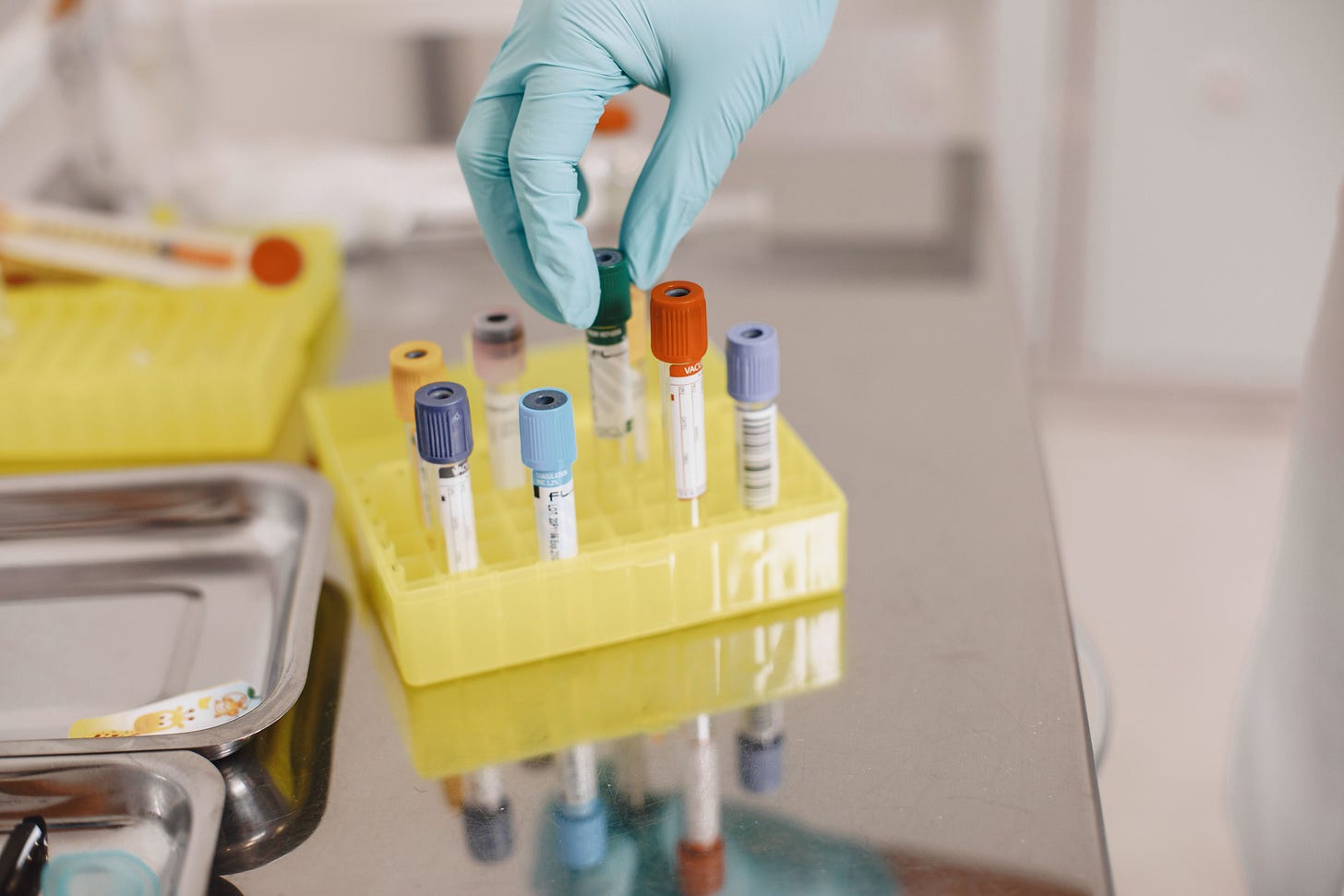
Image by Pexels, by Gustavo Fring.
If you’ve ever asked for a “full panel” and assumed herpes was included - you’re not alone - and you were unfortunately probably mistaken. Many GPs and testing centers simply don’t offer herpes testing for people without symptoms. And know that false positives are much more likely with HSV than with chlamydia or gonorrhea tests. It can also take 16 weeks or more after an exposure for a blood test to detect a new infection. The risk of psychological harm after a false positive is part of the reason testing isn’t more commonly recommended.
The most reliable test is a swab of an active sore, which means you often have to catch it in the act. If you have a sore, blister, or unexplained irritation, get it swabbed quickly, ideally within the first day or two if you can.
Herpes can also be passed when the person carrying it has no symptoms at all, through what’s called asymptomatic shedding, when the virus is active on skin that looks normal (valacyclovir prescribing information). Many people with HSV don’t know they have it. That’s part of why the virus is so widespread - with a lack of clarity about just how widespread. And that’s partly why so many people who get it can’t trace where it came from.
This is where things get dicey in our communities. On one side, some people feel that disclosing HSV is unnecessary if likely more than half the population carries HSV-1, mostly in the form of cold sores. Many people with HSV-2 never have a noticeable outbreak. Treating genital herpes as a uniquely shameful confession, while oral cold sores go unmentioned, arguably adds stigma without adding much safety.
On the other side, plenty of people very much want to know. Genital herpes is lifelong, outbreaks can be painful, and a diagnosis can bring real grief and anxiety. When someone learns that a partner knew their status and didn’t share it, that can feel like a violation of consent, because they didn’t get to make an informed choice about their own body. In a community built on negotiation and disclosure, withholding that information works against the agreements everything else rests on.
Both of these perspectives have validity, and I don’t think either one cancels the other. What helps, in my experience, is building disclosure norms that treat HSV as ordinary information. That means disclosing a known status as a matter of routine, the same way we’d share a testing date. It means receiving a disclosure without punishing or moralizing.
And we of course want to implement the protections that we have available. Daily suppressive antiviral medication cuts transmission of HSV-2 by about 48% in a large trial of couples where one partner had it (HealthDay). The lowest transmission rates came from combining that medication with consistent condom use. Avoiding contact during outbreaks - and during the tingling or itching that often comes right before one - helps too. None of this gets risk to zero, and together it gets it remarkably low.
A herpes diagnosis can feel enormous at first, and the clinical facts don’t always reach the part of you that’s scared or ashamed. Some people I’d point you toward:
Safe Slut (@safe.slut on Instagram) is a sexual health advocate who was diagnosed with genital herpes in 2019 and now uses her platform to fight herpes stigma and promote safer sex.
Shaun Galanos aka The Love Drive (Substack and Instagram) is openly HSV positive and offers frank, warm advice, as well as an uncensored Q&A with herpes educator Emily Depasse covering disclosure, testing, medication, and rejection.
So where does all of this leave us? Mostly with a set of habits that make the risk smaller and the conversations easier.
Test on a rhythm. Some people test every two weeks, others every three months. Pick a cadence that feels like a fit for how many new, community active partners you’re engaging with regularly.
Ask for tests by name. A “full panel” varies by clinic. If you want trichomoniasis, Mgen, or herpes testing, say so.
Get anything new looked at quickly. A sore, a rash, unusual discharge, or burning is worth a visit while it’s still visible.
Match your barriers to the route. Sometimes we forget that condoms aren’t the only barrier available. Gloves, dental dams, and latex undies can be kinky and hot when you use em right. For skin-to-skin infections, avoiding contact during outbreaks, suppressive medication, and vaccines like the HPV vaccine carry more of the load.
Treat disclosure as an ongoing practice. Share screengrabs of your results, your known statuses, and/or anything that’s changed since you last talked. Receive other people’s disclosures with the same calm and care you’d want for your own.
When an infection does come up, and over a full and adventurous sex life one probably will, it’s not always helpful to place blame. Sometimes the source of infection matters, if someone knowingly hid a status or when they might need to be aware of risk to others. Often, though, it’s unknowable, or the infection is one that doesn’t follow a simple chain from one person to the next. Think about disclosure and information gathering as community care. How and who does more information benefit?
We start from the honest premise that some risk is always left over, and we build the kind of community where people can say yes or no to that risk with the information available.
For deeper support, you can learn more about my services at intimacywithlaura.com.
Original Post: Laura Ramadei

Scan to download
Comments
Join the conversation — create a free account to comment.
Join the conversationLoading comments…