KINK & BDSM
Calling Men Daddy and the Politics of Ick
The ick is wisdom, not internalized patriarchy. One woman traces her Daddy kink through guilt, bad breakups, and the moment her body finally proved it right.
The ick is wisdom, not internalized patriarchy. One woman traces her Daddy kink through guilt, bad breakups, and the moment her body finally proved it right.

When I first started dating again, as a post-divorce single mom, I realized something troubling. My body seemed to eroticize things that flew in the face of my feminist values. I craved surrendering to a strong, powerful man who was going to take care of me and tell me what to do. I wanted to feel overpowered and held by benevolent hands stronger than my own. My body pulsed and lit up in response to the central figure around which patriarchy orbits—the father figure, and in particular, the one we know in childhood—Daddy.
For a long time I tried to quiet this longing in me. I felt convinced that it was manufactured—evidence that even my sexuality had been colonized by patriarchy’s central lie: that women are perpetually vulnerable, and submission and loyalty to male dominance keep us safe. It wasn’t lost on me that the same masculine visuals that Trump romanticized in places like Russia or Poland—think buzzcut soldiers waving at adoring children with calm resolve—infected my fantasies. It felt obvious that I’d fully internalized the right-wing logic of “the only thing that can protect you from a bad guy with a gun is a good guy with a gun.” That’s what I thought my desires meant.
And so I tried to contain them. I dated self-avowed feminist men who were in therapy and read bell hooks. They knew all of the modern progressive rules about consent and boundaries. With them, I explored my desire to be dominated. We had safe words, discussed limits, and together we had sex that was “safe”—meaning it happened under spoken rules and agreements and when it ended we were equals again.
But this post-sex return to “equality” disgusted me—my body physically rejected it in the form of the ick. The pleading eyes of the first man I called Daddy still haunt me. When our roleplay ended, those eyes would look at me and openly beg for affirmation. Please tell me I did a good job, they seemed to say. And without quite meaning to, before he even asked me with words, I would find myself reflexively soothing him. I hugged him. I made a point of looking effusively satisfied. I made sure he felt like a man. There was a forcefulness in the desperation in those eyes that made me afraid of what might happen if I didn’t.
Sometimes he’d cry to me because he felt like he couldn’t be himself around his friends, or because he thought his colleagues disliked him. Gross, I thought, and immediately felt guilty about feeling so repulsed. Here was a man, openly sharing his feelings with me, and yet it made me want to recoil. It felt like further evidence of how thoroughly my body had absorbed patriarchal rules around what makes men attractive. Pushing through the repulsion felt like the right thing to do. It made sense to me that I’d have to work to decolonize my own mind of internalized patriarchy.
But the ick grew sustained and undeniable, and even though I felt guilty, I eventually broke up with him. When I did, he yelled and cried. I don’t remember what he said, but I remember his red face, the spittle flying from his lips, and myself vomiting in front of him out of fear. When I went home and stopped answering my phone, he bombarded me with texts.
I can’t believe you
You are awful and selfish
You won’t even talk to me?!
You said you loved me!
Please call
I don’t know what to do please
I will be ok if u can just call me
You are the only person who can help
Please
As a mother can you please
In that moment the wisdom of my ick became clear.
I wasn’t recoiling from his vulnerability. I was recoiling from the hypocrisy that his idea of “equality” was still riddled with expectations of maternal care. Our Daddy roleplay was negotiated and explicit and yet, when we returned to our status as supposed equals, what that really meant was that I was the caretaker. That I was the one expected to be the emotional sponge, porous and absorbant, able to cleanse him of his bruised masculinity with my gaze of unconditional, feminine love.
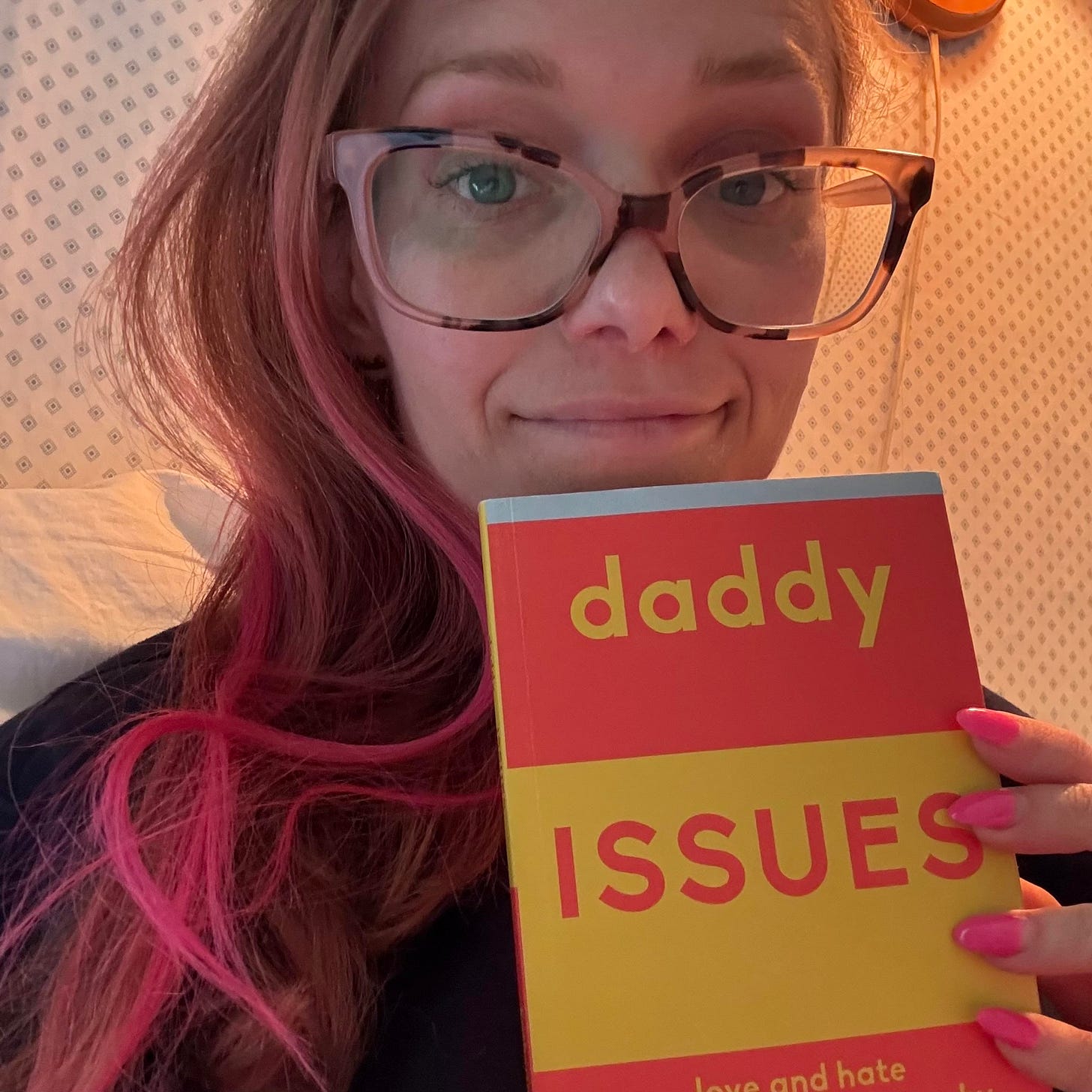
Katherine Angel writes about this demanded gaze in her book Daddy Issues. She describes the expectation that a woman become a mirror for another’s need, reflecting back reassurance, steadiness, affirmation.
Describing her own rejection of this expectation, she writes:
The people whose eyes I cannot meet are those in whose gaze I can detect the overwhelming clamor of requested affirmation. Those in whose gaze lies a demand for recognition, and a request for compliance. I hate to be made into the mother whose maternal gaze is demanded, the gaze of mirroring and recognition. When I only exist as a mirror for someone else, I cannot go on looking.
[
A must read.
Despite a supposed commitment to feminist, consent-forward relationships, many men were still expecting me to demonstrate my love by disappearing into mirrorhood. As a mother, can you please…disappear. Become a mirror for me. Only don’t show me what I am, show me what I wish I was. Make me believe I am who I want to be.
What that man was really asking for when he invoked my motherhood to implore me to stay, was to continue the patriarchal charade of love that has long been demanded of women. He was asking me to stifle my desires and intuition in order to protect him from the pain of my rejection. He felt entitled to it.
His avalanche of emotional dumping wasn’t vulnerability, it was what Isle McElroy has called “petulant vulnerability.” In their 2022 essay in The New York Times they describe the difference, writing:
If true vulnerability means accepting change, personal fallibility and the human condition of reliance on others, petulant vulnerability feigns emotional fragility as a means of retaining power.
I wasn’t wrong to feel the ick. I was wrong to override it.
In her book, Uses of the Erotic, Audre Lorde writes:
As women, we have come to distrust that power which rises from our deepest and nonrational knowledge. We have been warned against it all our lives by the male world, which values this depth of feeling enough to keep women around in order to exercise it in the service of men, but which fears this same depth too much to examine the possibility of it within themselves. So women are maintained at a distant/inferior position to be psychically milked, much the same way ants maintain colonies of aphids to provide a life-giving substance for their masters.
But the erotic offers a well of replenishing and provocative force to the woman who does not fear its revelation, nor succumb to the belief that sensation is enough.
When I started treating my ick as wisdom, I saw that my longing was wisdom, too. And when I stopped trying to justify my desire, I began to see that my longing for a Daddy had always been pointing me away from reproducing patriarchal relationship scripts. I didn’t want compartmentalized kink scenes in otherwise “equal” relationships—I wanted a fundamental reshuffling of unspoken expectations. I wanted relationships that relieved me of this patriarchal burden of disappearing into mirrorhood. I wanted to be seen by someone who could reflect back reassurance, steadiness and affirmation, not because they were afraid of what I would do if they didn’t, but because they chose me and believed in me.
The thing that made me light up wasn’t a performance of masculinity—it was a grounded, earned paternalism that didn’t demand I show love by disappearing. Once I understood that my desire wasn’t just about a certain type of sex, but about designing entire relationships around redirecting the flow of emotional regulation, it became clear that my body had been on to something deeply aligned with my values, not in contradiction with them.
In those early days of exploring my Daddy desire, I hadn’t yet learned to trust my body’s alarm system. That was the patriarchal conditioning that needed to be undone. I needed to give myself permission to stop feeling guilty about my ick, because that was a part of my “deepest and nonrational knowledge.” That knowledge was not something that needed extraction or undoing. Whether it manifested as ick or yearning, that knowledge, and my ability to trust it, needed nurturing and tending. And that is what my desire for a Daddy has always been: a desire to have that part of myself, my deepest and nonrational self, revered, encouraged, and parented.
Original Post: Saga McFarland

Scan to download
Comments
Join the conversation — create a free account to comment.
Join the conversationLoading comments…