RELATIONSHIPS
The 5 Hidden Distortions Bleeding into Your Relationships
(And How to Unveil Them)
(And How to Unveil Them)

I posted this carousel over on instagram and it was doing pretty well so I figure, why not expand here. So let’s start with this… if you’ve spent any time in relational or non-monogamous spaces, you know how easy it is to blame the external structure. We focus on communication protocols, calendar sync ups, boundary frameworks, and explicit agreements.
Yet, even with perfect agreements, the same underlying anxieties keep showing up again and again. And idk about you but for me it was high time i figured out WHY
In classical yoga philosophy, we call these internal distortions the Kleshas—the five foundational “veils” or colorings of the mind that obstruct clear perception. When a Klesha is active, you aren’t actually responding to your partner, friend, or family member in real-time. You are responding to the distortion projected onto them. This is something that has been a HUGE part of my practice especially navigating new connections.
What i’ve learned through this practice of self study into my kleshas... is this….
Relational security isn’t about micro-managing the external container. It’s about clearing these lenses so you can see what is actually happening right now.
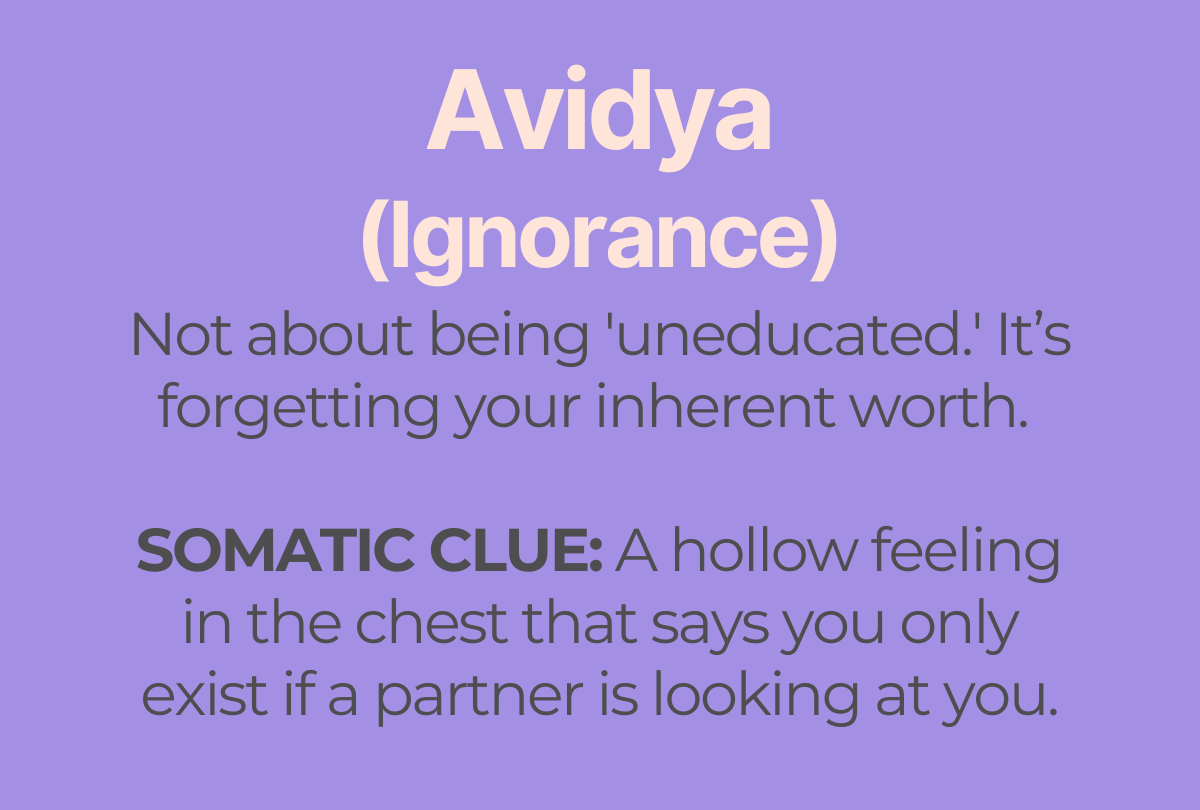
The Core Distortion: Forgetting your inherent worth and wholeness.
Avidya isn’t about a lack of intellect or education; it’s more like a spiritual amnesia. It’s the foundational loss of connection to your innate completeness, causing you to seek validation externally just to confirm your existence. (One of the reasons my YTT begins with Yoga as Remembering). But what does it look like? How does this show up in REAL life.
Somatic Clue: A hollow, sinking sensation in the center of the chest—a somatic signal that says, “I only exist if someone else is looking at me.”
How It Shows Up in Relationships:
Polyamorous/Romantic: Believing you are only safe, desired, or worthy when receiving active validation or attention from a partner.
Platonic/Familial: Over-functioning or people-pleasing because you fear that being silent or setting a boundary will make you invisible or unloved.
The Personal Practice:
When that hollow sensation arises in practice, instead of reaching for your phone or demanding reassurance, pause. Place a hand over your sternum. Use breath to meet the emptiness directly, anchoring into the truth that your presence precedes anyone else’s perception of you.
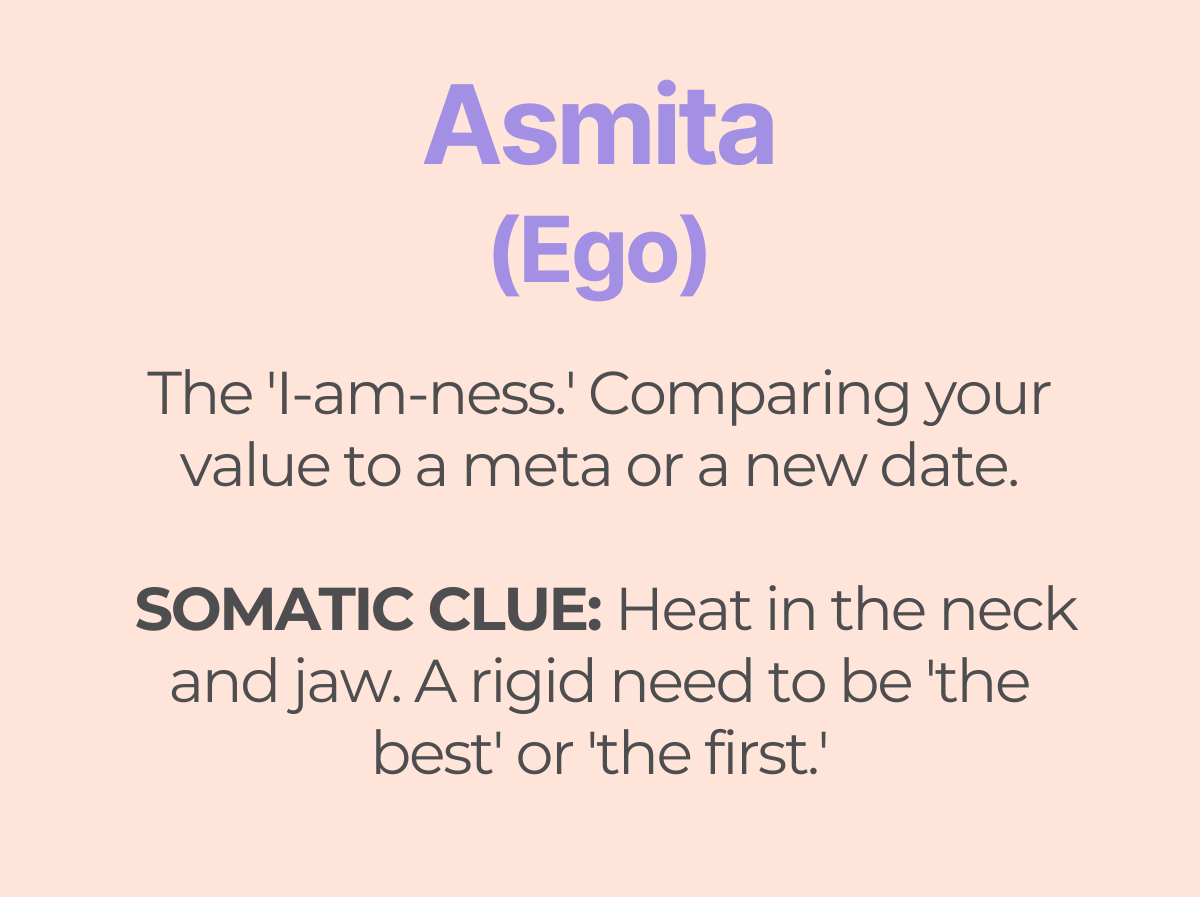
The Core Distortion: Identifying with temporary roles, status, or comparative value.
Asmita shows up in our real world when the fluid self gets hyper-locked into rigid identity constructs—”I am the reliable one,” “I am the primary partner,” “I am the successful one.” How does this show up in real life?
Somatic Clue: Heat rising in the neck and jaw, tension across the shoulders, and a rigid, defensive posture.
How It Shows Up in Relationships:
Polyamorous/Romantic: Comparing your value or standing to a meta, a new date, or an ex; a subtle need to be “the best,” “the first,” or “the most special.”
Parenting/Family: Feeling deeply threatened when a child or partner challenges your authority or doesn’t see you in the role you’ve constructed for yourself.
The Personal Practice:
Notice where you are defending an identity rather than engaging with reality. Practice unclenching the jaw and softening the upper throat. Ask yourself: “Who am I in this relationship if I don’t have to be ‘the best’ or ‘the one in control’?”
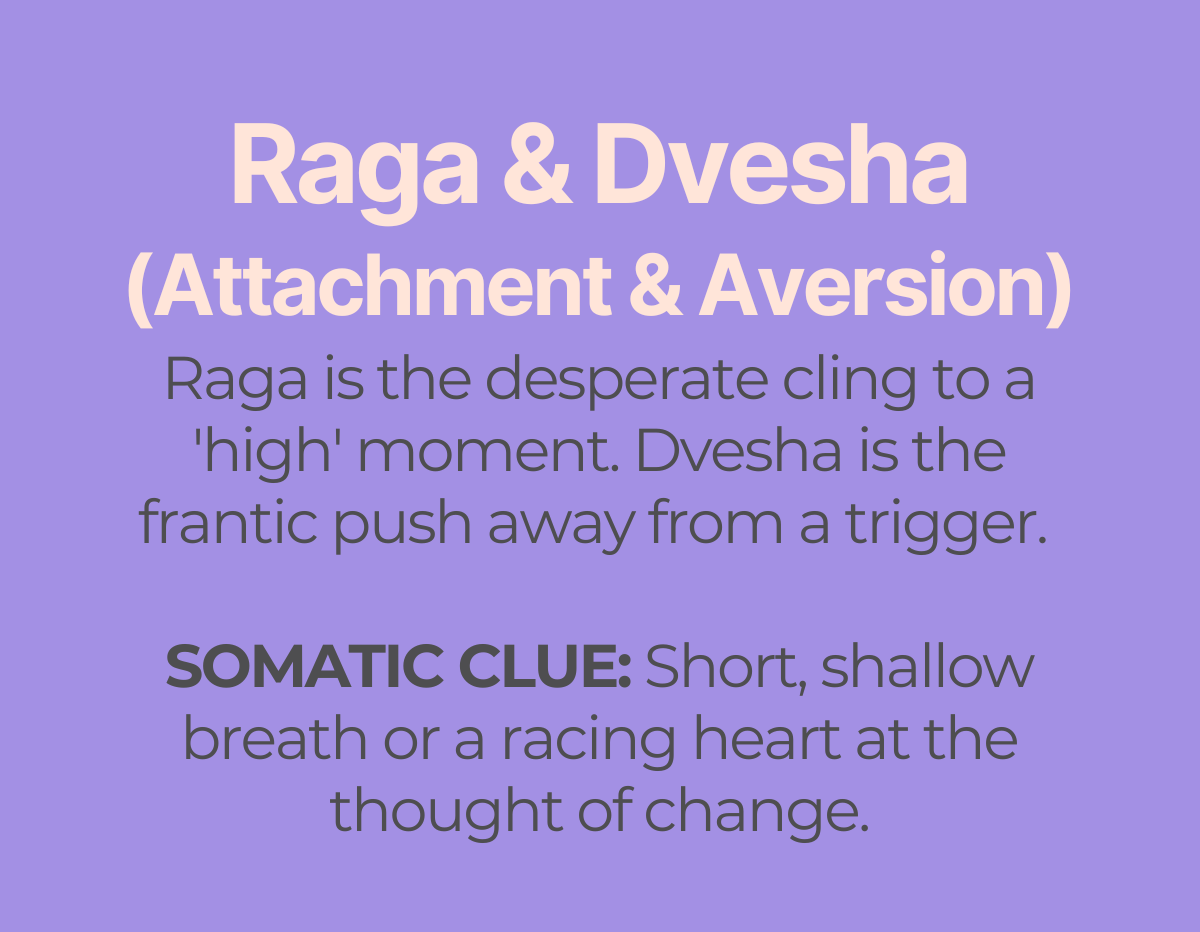
The Core Distortion: Grasping at pleasure (Raga) and frantically pushing away discomfort (Dvesha).
Now these two operate as twin sides of the same coin. Raga is the desperate attempt to recreate a past “high” or ideal state, while Dvesha is the reactive, panic-driven recoil from anything that triggers discomfort. What does it look like in everyday relational situations.
Somatic Clue: Short, shallow breathing, a racing heart, or a sudden spike of adrenaline at the hint of change or conflict.
How It Shows Up in Relationships:
Polyamorous/Romantic: Clinging to the initial “New Relationship Energy” (NRE) phase, or conversely, shutting down completely the moment a partner expresses a boundary that feels uncomfortable.
Friendships/Work: Escalating small disagreements into major crises (Dvesha) or avoiding crucial, necessary conversations just to keep a fake, comfortable peace (Raga).
The Personal Practice:
Track your breath. When you feel the urge to frantically fix a situation (Dvesha) or lock down a good moment (Raga), slow your exhalations down to lengthen the parasympathetic response. Practice remaining present with the natural ebb and flow of human dynamics without trying to control the tide.
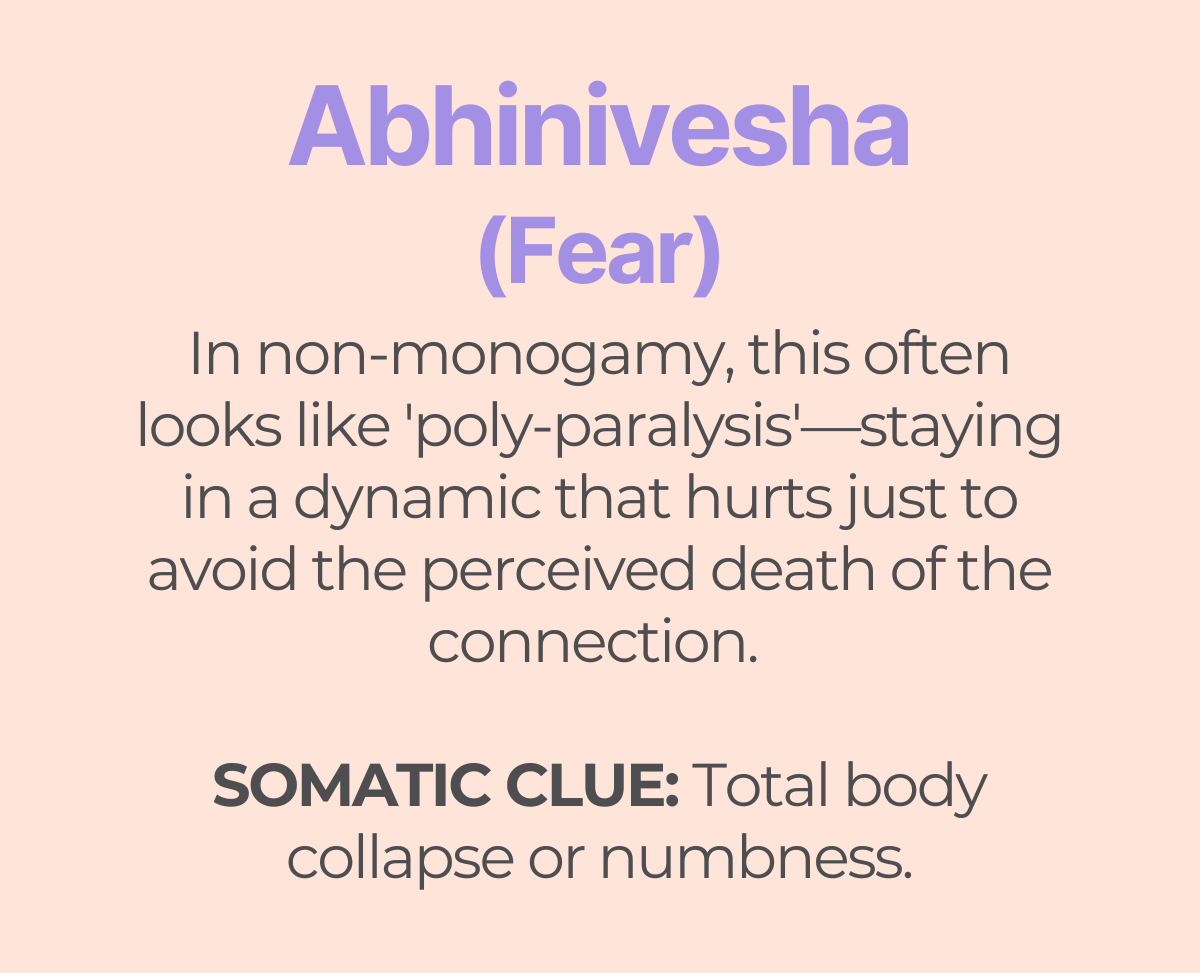
The Core Distortion: The instinctual fear of change, impermanence, or relational “death.”
At its root, Abhinivesha is the survival instinct firing in contexts where physical survival is not actually at risk. In relationships, it manifests as a visceral dread of transition, separation, or structural shift. And how can we spot this one in the wild?
Somatic Clue: Total body collapse, numbness, heaviness in the limbs, or a freeze response.
How It Shows Up in Relationships:
Polyamorous/Romantic: “Poly-paralysis”—staying in a painful, mismatched, or dysfunctional dynamic simply to avoid the perceived “death” of the connection or title.
Family/Community: Holding onto toxic family or group dynamics because the terror of stepping away feels greater than the pain of remaining.
The Personal Practice:
Recognize that transitions are not liquidations. When freeze or collapse sets in, practice ground-referencing: feel your feet firmly planted, notice five concrete objects in the room, and remind your nervous system that you are safe in the present moment, even as relational forms evolve.
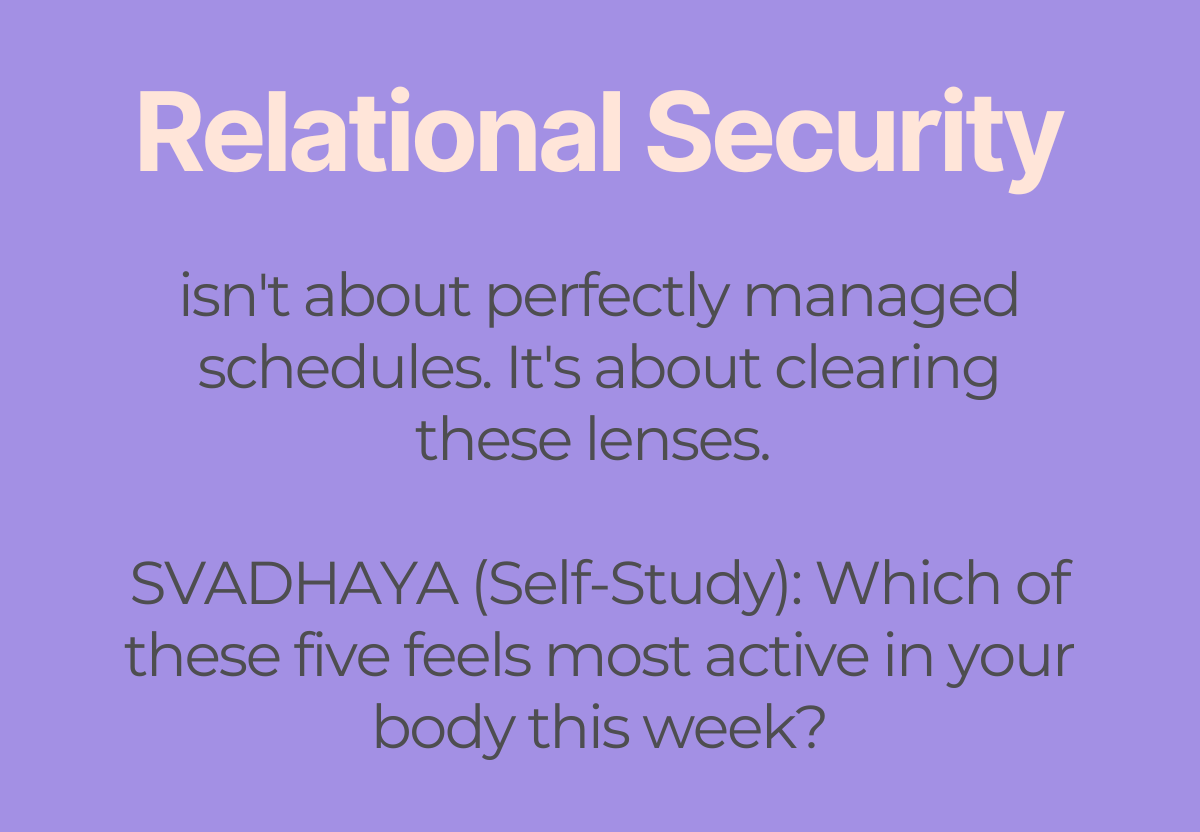
Relational security isn’t created by controlling every variable—it is built by cultivating the self-awareness to see through your own projections.
When you notice a rift, conflict, or wave of anxiety in any of your connections, pause before taking action and ask yourself:
Which of these five Kleshas is active in my body right now? What somatic clue is my system giving me, and what is it trying to protect?
When we clean the lens, we stop reacting to our past distortions—and finally start relating to the person standing right in front of us.
How does this flow feel for your reader base? Would you like to adjust the tone or expand further on any specific somatic practices?
Original Post: Javi

Scan to download
Comments
Join the conversation — create a free account to comment.
Join the conversationLoading comments…