JEALOUSY & COMPERSION
You Are Allowed to Need Reassurance
When reassurance helps us feel less alone, when it becomes a plea for rescue from uncertainty, and how we can let other people care for us when we’re struggling
When reassurance helps us feel less alone, when it becomes a plea for rescue from uncertainty, and how we can let other people care for us when we’re struggling
Before we get into this week’s essay: It is officially September 1, which means our little Fieldwork for the Heart experiment is beginning! For context about what I’m inviting you into: You can read more about the current experiment I am personally running within my own non-monogamous relationship ecosystem and why I think short experiments are the best way to find your own way through the wild unknown that is non-monogamous life beyond the relationship escalator. But essentially: throughout the month, you’re invited to choose one small, reversible experiment in how you are loving, relating, resourcing yourself, or building more of the relational lives you actually want. We’re using the community chat as a place to share field notes, witness each other, and share updates as we make intentional shifts and conscious choices in how we’re relating in this season. If there’s something you’ve been curious to try in your own relational life and you’d like a little community support as you do it, come join us in the Fieldwork for the Heart chat, which is free for all levels of subscribers for the month of September.
Want some company in your relational experiments? Share this post with someone you’d like to experiment alongside this month.
They’ll be sitting across from me with tears welling in their eyes, their mind already several steps into a future they don’t actually know is coming. Maybe their partner is going on a date, or has simply expressed a desire that activates some old fear of being left behind, and before they’ve fully expressed what hurts, they’re already trying to put what they’re feeling into its proper place: I know this is my trigger. I really don’t want to be controlling.
There’s another layer underneath all of that, something closer to: I don’t want to be back here. They’ve worked hard to become more secure and trusting, and the return of an old fear can feel like evidence that they’re somehow moving backward, away from whatever state of “poly enlightenment” they thought they had finally reached.
I know this feeling intimately. I’ve struggled more with polyamory over the past several months than I have in years, as grief and loss have changed the emotional landscape I’m trying to practice it inside. Fears I thought I had long since metabolized have resurfaced, and there have been moments when I’ve caught myself thinking, with an annoying combination of frustration and shame, Really? We’re back here again?
But I keep trying to be compassionate with myself because I know that our capacity for holding the complexity of a non-monogamous relationship ecosystem isn’t static; what feels spacious and light when we are well-resourced may feel extra stretchy when we’re grieving, exhausted, lonely, overwhelmed, or otherwise carrying more than usual.
Many of us have worked hard to unlearn the idea that our discomfort should automatically determine what another person is allowed to do, to understand that jealousy isn’t necessarily evidence of wrongdoing, and to stop expecting our partners to protect us from every difficult feeling that non-monogamy might evoke. So when we suddenly need more reassurance, more closeness, or more help finding our footing, it can be surprisingly easy to interpret those needs as a problem, or to assume that if we were really secure or “good at poly,” we wouldn’t need so much from anyone else.
Yes we absolutely do want to own for our wounds and our big feelings. But growth and self-responsibility don’t necessarily mean that the frightened parts will stop showing up completely. And lately I’ve been wondering which part of us is speaking when we rush to qualify or contain what we’re feeling before we’ve even acknowledged what is alive within us, and what we might benefit from receiving from another person in those moments of fear, scarcity, or the urge to reach for control.
Internal Family Systems (IFS) has become one of my favorite frameworks for working with non-monogamy, in part because so many different parts of us can come online when we step outside the cultural map for how relationships are supposed to work. Of course one part of me can genuinely want freedom while another is scared shitless of what that freedom might cost me. Both get to be here.
IFS calls some of the parts that rush in when we’re scared protectors. They’ve usually gotten very good at whatever they learned might keep us away from pain, rejection, shame, abandonment, overwhelm. And, as I wrote about recently, they can get so urgent about protecting us that we hand them the keys and let them start making enormous relationship decisions.
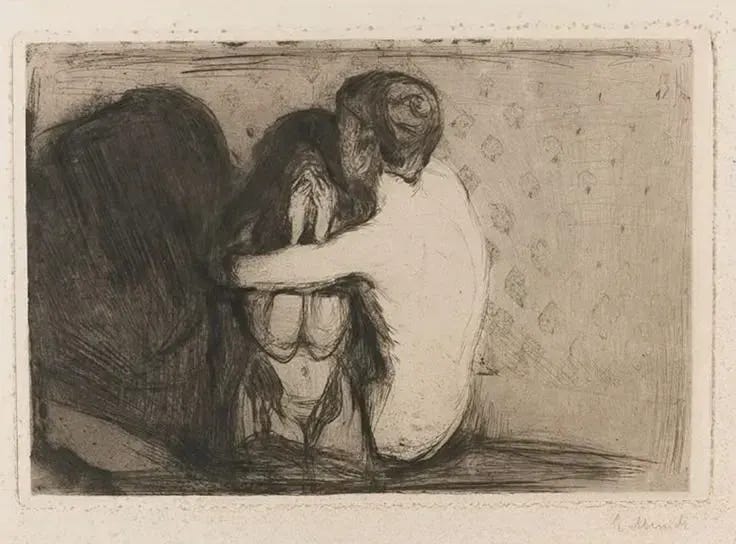
And underneath all that protection are often more vulnerable parts that IFS calls exiles: parts carrying old pain, fear, shame, loneliness, or unmet attachment needs that our protectors have learned to stand guard around. Richard Schwartz, the founder of IFS, sometimes describes these exiles as our “basement children,” an image I find painfully evocative: the young, vulnerable parts we’ve tucked away somewhere out of sight, still carrying their old fears and longings, still hoping someone will eventually come down the stairs and give them the care and nourishment that they’re so hungry for.
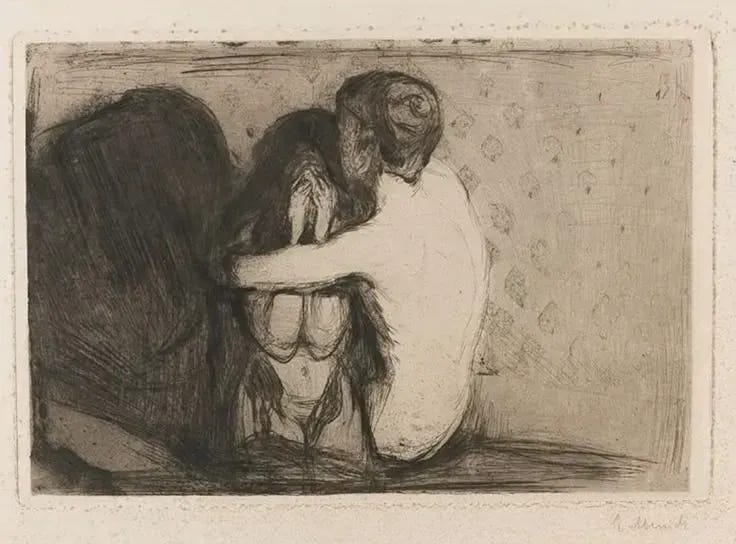
Edvard Munch, Consolation, 1894
So when someone says some version of: I know this is mine to work through, sometimes I hear a protector trying very hard to manage the vulnerability of an exile underneath it. The exile may be carrying a much more tender fear: Please tell me you still love me. Please don’t leave me alone. Please remind me that I matter to you, while the protector, anticipating what might happen if that need is exposed, rushes in with its own instructions: Don’t be needy. Don’t burden them. Handle this yourself.
The protector may be trying to spare that vulnerable part the risk of needing something from someone else and not receiving it. But becoming more Self-led doesn’t mean teaching our exiles to stop needing care. We can learn to meet frightened parts with curiosity and compassion without pretending that everything we need as humans can be generated internally.
Sometimes what we want from them is incredibly simple and human:
Could you hold me for a minute?
Could we have some intentional time together before your date?
Of course, not every request for reassurance is necessarily helpful. Reassurance can help us settle enough to stay present with a difficult experience, and other times we start relying on another person to make our fear go away. So how do we tell the difference between asking someone to care for us while we’re activated and making them responsible for ending our activation for us?
Original Post: Aria Diana

Scan to download
Comments
Join the conversation — create a free account to comment.
Join the conversationLoading comments…