METAMOURS & STRUCTURES
When the Relationship Becomes the Whole Horizon
Aria Diana's field notes on self-partnership after grief: why widening your attention beyond one relationship builds a healthier non-monogamous ecosystem.
Aria Diana's field notes on self-partnership after grief: why widening your attention beyond one relationship builds a healthier non-monogamous ecosystem.
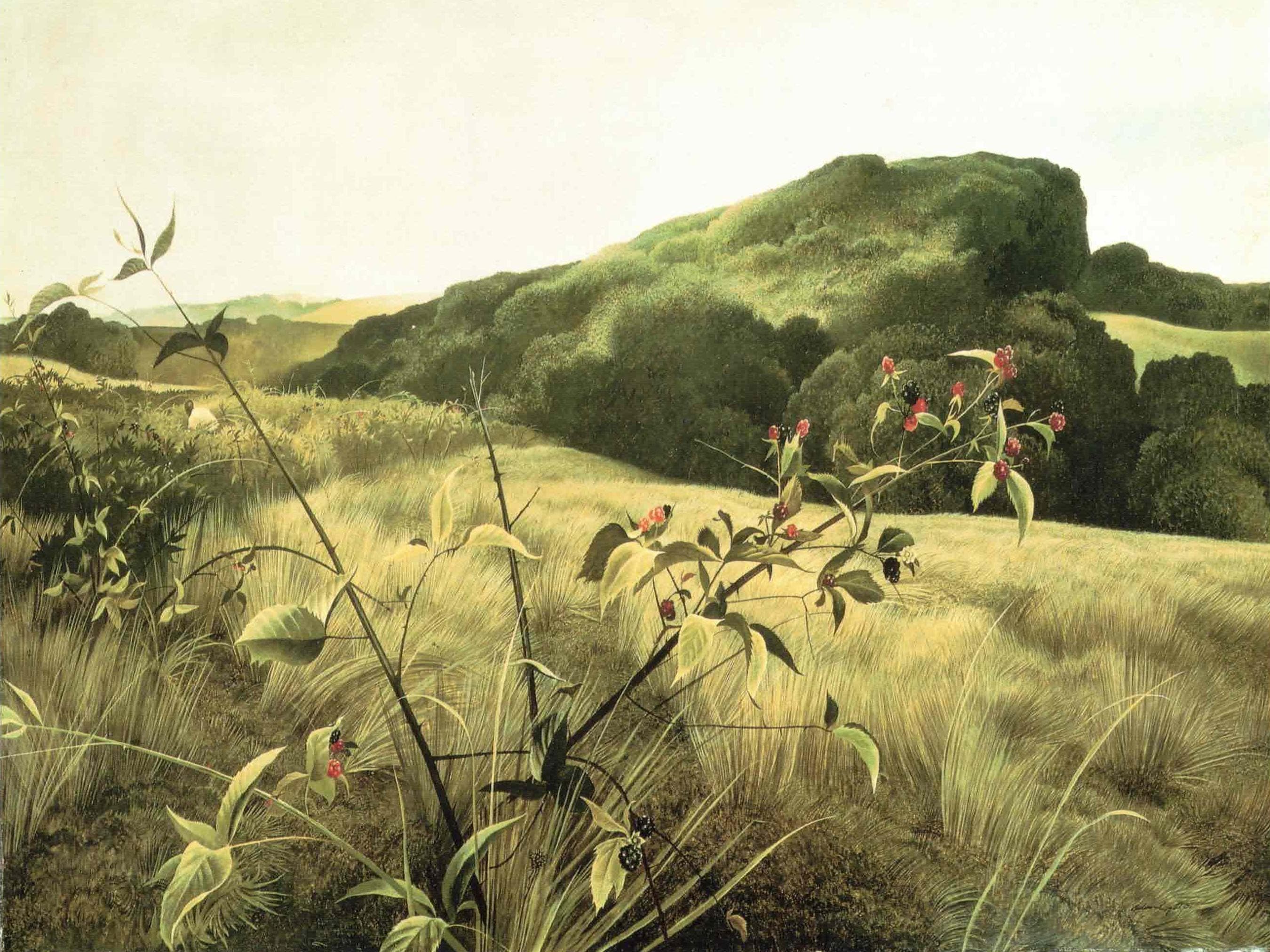
This week, I’m sharing some meandering field notes from my own self-partnership experiment in tending my heart after a time of grief, widening my relational ecosystem to include more of the natural world, including a few observations about what invasive blackberries are teaching me about building healthy, balanced non-monogamous ecosystems. Plus a few super sweet updates from people experimenting alongside me in our Fieldwork for the Heart community! My heart is full 🥰
If you’re new here, Fieldwork for the Heart is a free community experiment where we’re choosing small, real-life relationship experiments, trying them out, and sharing what we learn along the way.
And if you haven’t joined us yet, it’s not too late to come play! We’re gathering lived data and cheering each other on along the way. We officially cross into autumn on Sept. 22, so consider this your final seasonal invitation to choose one small thing you’re curious about temporarily adjusting. Wouldn’t it be lovely to start a new season with just a touch more alignment? I’m already wildly delighted with the data I’ve been gathering, myself.
Read on below for some of what I’ve been noticing in myself and my community plus some of what I’m pondering during this time with the trees and rivers of Northern California.
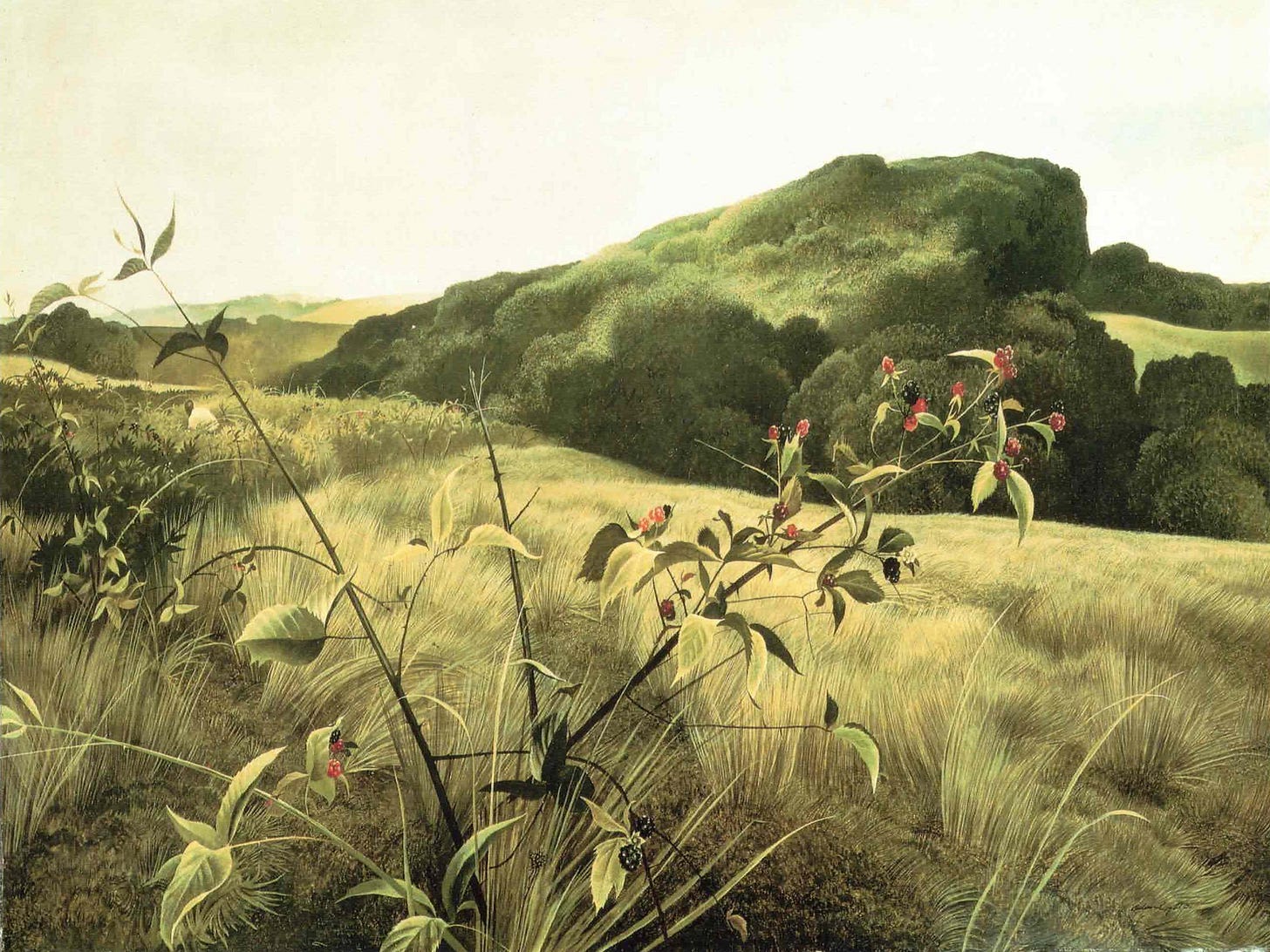
Andrew Wyeth, Blackberry Picker, Circa 1943
A common pattern I’m noticing amongst many of us practicing non-monogamy is that when something feels activating in a relationship, we want to urgently solve things to help us escape the discomfort.
And I think this is where we can find ourselves spinning our wheels. What if, instead of trying to escape the discomfort, we practiced building enough capacity to keep breathing while we’re inside of it?
Because the thing about non-monogamy is that it can create a lot of complex, liminal situations where it’s extremely hard to predict what’s going to happen next. When things are changing (ie new dating partners enter the scene, NRE starts to bubble, conflict happens, or relationships de-escalate, end, or transform), we can find ourselves sitting with complex uncertainty about what these changes will mean for us and our relationships.
It can be a lot to hold all of this, especially when more than one of these kinds of changes is happening simultaneously for you, your partner(s), and/or their partners. Sometimes it feels like the ground is shifting sideways and backwards and forwards at the same time, do you know what I mean?
Our nervous systems can have a hard time settling when things are unpredictable and wobbly like this. And recently it feels like learning how to stay with ourselves through the swirl of change is really the practice.
When we open ourselves up to connection with other humans, we are indeed inviting change and possibilities we sometimes couldn’t have imagined.
And I see so many of us come up with pretty ingenious protective systems for dealing with the discomfort of not-knowing what happens next.
On one end of the spectrum, we can become almost prosecutorial, asking 1,000 questions in search of certainty. We want to understand what happened, what it means, and what the other person is thinking in hopes that if we can just gather enough information, maybe we can finally figure out what to DO.
And then there’s the opposite approach: deciding we actually can’t hear ANY details about what our partners are doing because knowing more might reveal just how uncertain everything is.
Different strategies, but both can be attempts to make relational uncertainty feel more manageable, because when we’re activated enough, these protective parts of us can become pretty determined to find a way out of it RIGHT NOW.
I’ve been discovering some little relationship lessons from the blackberry bushes around the land where I’m staying, especially about what happens to our attention when we’re searching for certainty.
What’s wild is that I’ve spent a lot of time here, but the seasonal creek and blackberries have never been here quite like this before. I came out to these quiet hills to be close to the Yuba River, only to discover running mountain water here waiting to greet me, close enough that I can hear the gentle babble when I sleep.
So I haven’t yet made it to the Yuba, because honestly, an hour+ round trip on a scorching summer day is suddenly less appealing than just sauntering down to the water that’s flowing so freely and sweetly right outside my door.
It feels like there’s another polyamorous relationship metaphor in here somewhere about the fear of a game-changing new relationship: what if all the effort required to maintain a connection with obstacles, distance, or friction suddenly feels less worth it when something fresh and accessible surprises us right outside our door? I mean, that is one possibility. 😬
Don’t get me wrong: I’m still planning to visit the Yuba eventually, just with a bit less urgency.
All of that to say…. I’m feeling a version of NRE with this precious creek and the blackberries I’ve been harvesting and eating warm from the sun.
Before I arrived here, I went to a community singing retreat nearby led by the incredible Phoenix Song over Labor Day weekend, and my heart got filled ALL THE WAY UP. I’ve learned in the last few years that group singing is one of the best co-regulation practices for helping me feel a deep sense of resonance and belonging with other humans (what Frances Weller calls a “primary satisfaction”).
I came away from that retreat with a bunch of new songs reverberating through my mind and body, including, “Oh River” by MaMuse. Someone at the retreat shared it with me and told me it was written in and for the Yuba River. The lyrics are perfect: “Oh river, I hear you, feel you calling me…”
And now I’ve been bringing these new melodies down to the creek with me. As I harvest the blackberries, I’ve been singing some of the new songs I learned in community, sharing them with the water and berries as a tiny gesture of reciprocity for the wild food I’m gathering.
I have been loving this sense of abundance, almost as if the bushes are just waiting for me to notice and lovingly accept their gifts.
And while these berries are offering me so much sweetness, the paradox is that the bushes are also extremely invasive.
Along one stretch of the creek, they’ve grown so thickly on both sides that it’s almost impossible to see any other life. I keep being in awe at just how many berries there are here, but the reality is that this actually isn’t a healthy ecosystem when they are almost the only thing growing in many places.
As I was walking down the long country driveway this past weekend, I noticed one patch of vines had climbed up the hillside from the pond down below, wrapping themselves over the top of a small manzanita tree.
I felt my belly tighten with the recognition that this kind of unchecked growth is exactly what can happen to our attention in relationships.
And in non-monogamy, I notice three particularly potent ways a relationship can start taking up the whole field: the expansive pull of NRE, the contracting grip of possessiveness, and the looping attention of rumination.
NRE can have us orienting more and more of our attention toward something new and delicious, which can be fun and joyous, while also making us lose perspective sometimes in the rush of all those feel-good chemicals.
Possessiveness can have us wrapping our attention more and more tightly around a relationship when we’re afraid of what might be changing.
And rumination can keep our attention circling the relationship as we try to think our way toward certainty: replaying conversations, analyzing someone’s behavior, imagining possible futures, and trying to figure out what everything MEANS.
Why haven’t they texted? What does this mean? Are we okay? What are they doing with that person? Do they like them more? Can I ask for more reassurance? Do we need a new agreement?
One thought grows into another and another until it becomes difficult to see what else is growing in the landscape.
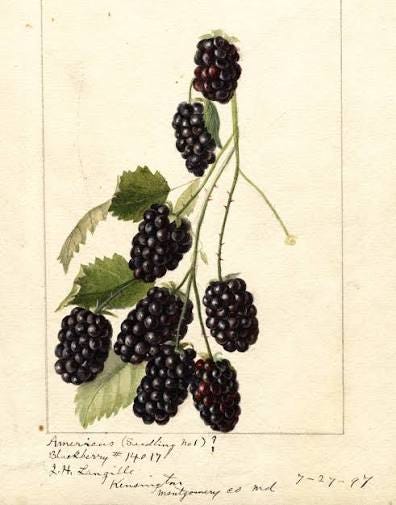
Deborah Griscom, Passmore Watercolor Collection, 1897
When I notice one relationship starting to take up more and more of my attention, I’ve been practicing widening my perspective to remember the other sources of nourishment and care that are available to me.
And particularly when I’m activated, instead of focusing only on what I need my partner(s) to do so I can stop the uncomfortable feelings, I’m practicing zooming out from what my nervous system is trying to hyper-focus on:
What else is here that wants my attention?
Who else loves me?
What brings me pleasure, belonging, curiosity, or aliveness?
Who else can I connect with to remind me that I’m still cared for?
And before I decide what the relationship needs:
What do I need to feel more resourced in my own body right now?
Right now, that looks like taking off my shoes and standing in the creek. Feeling the soothing flow of the cool water on my bare legs, listening to the soft rush of water over rocks, noticing the way the fading afternoon sun glimmers as the water striders skip carelessly across the surface.
All of this is a practice of letting my awareness expand beyond the pressing relationship question that my mind has been trying so hard to solve. Bringing this energy back to myself is a practice of self-love, and it’s the best way I know how to build my capacity to sit in the discomfort of the unknown.
And to be super clear, widening the field doesn’t mean we shouldn’t need anything from our partners. Our attachment needs are real, and needing reassurance, care, repair, or support from the people we love is not something to feel guilty or ashamed about. This is simply a practice of getting more resourced in our own bodies before we try to figure out what the relationship itself needs.
It’s also about remembering that our partners are not the only relationships, places, and practices available to nourish us.
I’ve been thinking about resourcing as both an in-the-moment and proactive practice:
In moments of activation: Can I widen my awareness enough to notice what else is available to support me right now? What might help me expand my capacity enough to have more choice about how I respond?
And proactively: Am I tending the relationships, places, and practices that help me feel nourished and resourced before I’m in a reactive state? Friendships, community, creative work, solitude, pleasure, movement, rest, land, plants?
So all of that to say…
The berries are sweet, and I want them here. But what I’m pondering is: how do we give our blackberry bushes enough of a container that they can flourish without taking over the whole landscape, leaving room for other things to peacefully grow alongside them?
How do we let a relationship be deeply juicy and nourishing without the big energy of NRE, the heavy energy of possessiveness, or the looping energy of rumination squeezing out other life? How do we actually build balanced, nourishing relationship ecosystems?
Increasingly, I think part of the answer is intentionally cultivating other places to belong and receive care. Because when one romantic relationship becomes the place we look for reassurance, belonging, pleasure, intimacy, safety and meaning, it can become harder to see everything else that is available to feed us.
We need to rebuild a village of care and remember the practices, people, and places that nourish us.
I keep thinking about the little circuit of nourishment happening here at my temporary mountain home:
The songs were shared with me through other big-hearted humans. I carried them down to the creek and sang them to the berries. The berries fed me, fresh from the vine. I gathered enough to make baked oatmeal to share with the friends who are sharing their sanctuary space with me this month. And maybe, together, eventually we can think about how to restore some more biodiversity to their watershed. This is the kind of relationship ecosystem I’m increasingly interested in: one where nourishment circulates.
I don’t want the trees and the creek and the blackberries to become another kind of self-care product, there to calm my nervous system so I can get back to being productive or make “the correct” relationship decisions. I want to practice relationship with them, too.
I am receiving something here. What does it mean to really notice that? To offer attention or gratitude in return? To let myself be changed by the places and living beings that care for me?
A few weeks ago, I invited people to choose something about their relational lives they were curious about and run a small experiment instead of trying to think, plan, or study their way toward an answer.
It takes courage and capacity to get out there into the field, rather than analyze possibilities from the sidelines!
And I am loving watching all of the experiments unfold alongside me in our community chat.
People are experimenting with solitude, kinky desire, creativity, vulnerability, grief, autonomy, asymmetry, self-trust, community, capacity.
One mother wanted to know what would happen if she took several weekends to focus on herself and her own pleasure, inside of her usual full-time role as a mom. She was worried about how her teenage kids might respond, so I encouraged her to sit down with them and figure out what they would need in order to feel cared for while she took some space for her own nourishment.
She did, and suddenly she had more information. She could make plans for care based on what her kids actually told her they needed, and then go live the next part of the experiment and remember that her human body deserved to enjoy itself beyond the role of caretaker.
Another person in our community, Z (whose story I’m sharing with permission), was grieving two relationship endings with people who still live nearby.
Their neighborhood had become charged with the possibility of encountering them. Walking familiar streets could become an exercise in scanning:
Will I see them? Are they going to be there?
Z initially imagined an experiment in simply getting themselves out there and walking anyway.
I wondered what might happen if they gave themselves a new relationship to move toward, rather than organizing the experiment around what they were trying to avoid.
And I didn’t mean “open up the apps and go find a new human to distract you.”
I meant: what if they actively built a relationship with some living part of the neighborhood itself?
Maybe there was a particular tree they could visit, or a garden, a park, a patch of earth. Maybe they could meet a new tree and sit underneath regularly.
What else might become visible if their attention wasn’t always organized around Will I see them?
Z found dahlias.
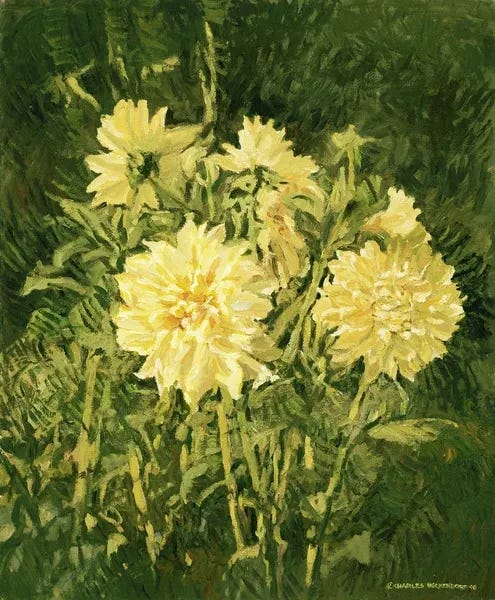
Dahlias, Charles Beckendorf, 1990
They’ve been visiting the same patch throughout September, watching the flowers bloom and wilt and making little sketches as they go. In the process, they’re also returning to drawing, something they love.
And the experiment hasn’t magically made the neighborhood less tender. Z has had a few chance encounters with the people they were hoping not to run into, and those encounters opened the wounds a bit, again. Their sketches and outings both still feel a little awkward, but they also noticed that when they’re with the flowers, holding a pencil or pen or charcoal and becoming immersed in what they’re doing, there’s a moment when their mind comes fully into the present:
“And I’m home. If only for a moment,” they wrote.
I adore this experiment because it’s not trying to deny the sadness of losing connection with those two humans, or somehow resource Z so perfectly that running into them doesn’t hurt.
The grief still gets to be there. The wounds are still healing. But now there are dahlias and beauty there, too, and a growing relationship with a place they increasingly feel they belong to.
And this is why I love experimentation (and being witnessed in community) so much.
We don’t have to know in advance whether something is going to “work.” Sometimes the thing we were afraid would happen actually happens! And then we get to notice: Okay, what happened in me? What helped? What was still hard? What else became possible alongside the hard thing?
We get to try something, pay attention to what happens, learn from and be inspired by each other, and use that information to decide what we want to try next.
The fall equinox is approaching on Sept. 22, which means there’s still time to join us for this first round of Fieldwork for the Heart.
If you’ve been hanging out in our community chat reading everyone else’s experiments from the sidelines, consider this your final invitation to jump in for this round of seasonal experimentation before we close out our communal data collection right after the autumn equinox. (And if you’ve been running an experiment already, share some updates with us!)
It doesn’t need to address your biggest relationship question but maybe there is something small you’re curious about like…
What happens if I ask directly for the exact type of reassurance I’m craving?
What happens if I protect a few hours every week for something creative?
What happens if I make a plan to call a friend and listen to what’s alive for them the next time I notice myself hyper-focusing on what my partner is doing?
What happens if I finally go to that queer meetup / dance class / community meet cute / kinky event I’ve been thinking about?
What happens if I visit the same tree, creek, garden, swimming hole, or patch of dahlias every week and see what kind of non-human relationship develops that might help my body feel more connected and at ease?
Or maybe your experiment has nothing to do with any of these things.
What’s something you’ve been wondering about in your own relational life that you could actually try?
Make the experiment small enough that your actual life can support it (or share your messy thought process in the chat & I’ll help you distill it). Then go live it. And bring us back your field notes.
What happened?
What surprised you?
What became easier?
What got harder?
What do you want to try next?
We’ve got just a few more days of summer left. Let’s use this warmth and light as resources to try on some more aligned ways of relating before we settle into a new season.
Come do some Fieldwork with us 💛
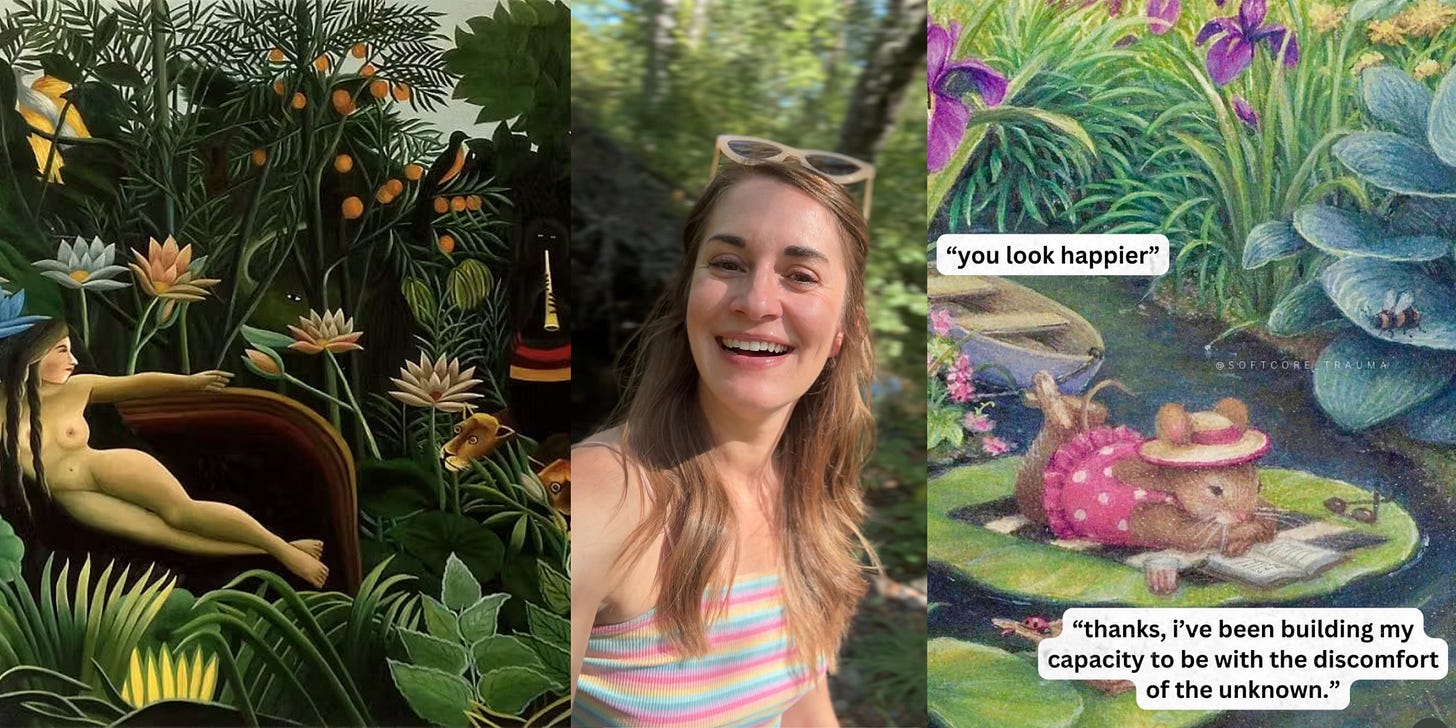
Self portraits from my forest sabbatical (credit: The Dream by Henri Rousseau & @softcoretrauma)
If these blackberry field notes gave you something to chew on, share them with someone you’d love to experiment building a more nourishing relationship ecosystem with. 💛
Want a relationship ecosystem that isn't all one horizon? Start with our guide to what ethical non-monogamy actually is, and if grief or uncertainty is what you're carrying right now, an ENM-aware therapist or coach can help you widen the field.
Original Post: Aria Diana

Scan to download
Comments
Join the conversation — create a free account to comment.
Join the conversationLoading comments…