MIND & BODY
What If It Doesn't Mean What You Think It Means?
Why our nervous system rushes to certainty—and what becomes possible when we don't
Why our nervous system rushes to certainty—and what becomes possible when we don't
A few days ago, a friend sent me a cheerful voice note that her mother had just been declared cancer-free. In the middle of her message, she said something that immediately hit home:
“She was so positive through the whole journey. It’s a shining example of how attitude shapes reality.”
The sentence landed so deeply that I wrote it on the chalkboard in my hallway:
Attitude shapes reality.
I’ve been chewing on that line as I come and go.
The last six months have been a season of grief after losing two family members in a row, including my younger brother’s partner, who was in her thirties and felt like a sister to me.
There’s been a heaviness that has subtly changed the lens through which I’ve been connecting with the people around me. And on more than one occasion, the grief has felt like anger.
I noticed that unintentionally, I’ve become more critical of some of the people I love most.
The criticisms often felt true. Lately, I've found myself wondering what other ways of understanding my relationships might have been available to me if I hadn't been carrying the weight of so much grief.
Two nights ago, I was sitting in a room of mostly strangers in Oakland when the song leader, Ríomas, began singing the same line over and over...
By the third repetition, I could feel something in me soften.
A particular relationship came immediately to mind. And I realized I'd become so convinced of one story about them that I'd stopped experiencing it as a story at all.
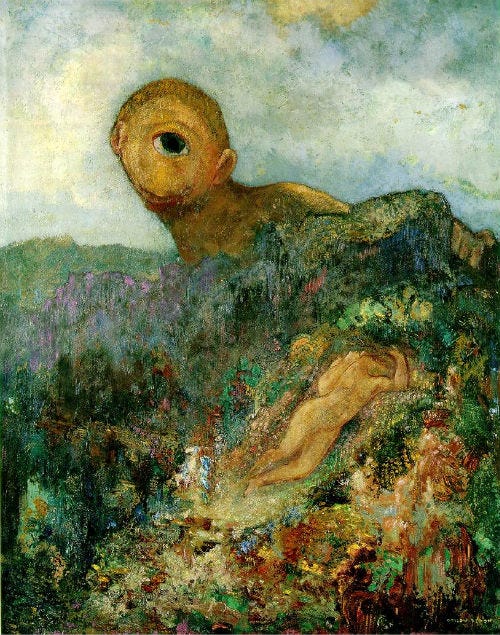
Odilon Redon, The Cyclops, 1914
The Meaning We’re So Quick to Make
Humans aren’t passive observers of our lives. We’re meaning-making creatures, constantly trying to make sense of what’s happening around us. The strange thing is that we usually experience the event and the meaning we make of it as though they’re the same thing. By the time we notice we’re hurt, afraid, or angry, the interpretation has often already happened.
I’m beginning to think that’s partly because uncertainty is so uncomfortable for the human nervous system. We don’t just want meaning; we want orientation. We want to know what world we’re living in and what we’re supposed to do next. So when something ambiguous happens, our minds often settle on the first coherent explanation they can organize themselves around—not necessarily because it’s true, but because certainty is easier to inhabit than not knowing.
And I’m beginning to think the real work of non-monogamy is expanding our capacity to remain inside uncertainty just a little longer before deciding what something means.
Which is why that lyric landed so hard.
What if it doesn’t mean what you think it means?
I can’t think of many questions that would spare people more unnecessary suffering in non-monogamy.
With non-monogamy, a delayed text can become a story that they’re losing interest.
A partner’s excitement about someone new becomes I’m being replaced.
Jealousy becomes Maybe I’m just not cut out for non-monogamy.
Those conclusions can feel immediate because there is usually a protective intelligence behind them—some part of us trying to take an uncertain experience and turn it into something we know how to respond to.
If they’re losing interest, I can pursue them.
If I’m being replaced, I can prepare myself.
If I’m fundamentally too jealous for this, I can stop trying and protect myself from the vulnerability of not knowing whether things might eventually become easier.
Our nervous system isn’t only trying to understand what’s happening. It’s trying to decide what action will keep us safest.
What happened?
What does it mean?
What should I do?
Pursue.
Withdraw.
Prepare.
Protect.
The story may hurt, but it gives the nervous system a plan.
There is almost always an invisible sentence between what happened and how we feel:
...which means...
Your partner is distracted...which means they’re losing interest.
They cancel plans_...which means I’m not important._
They fall in love with someone else_...which means I’m being replaced._
We rarely notice ourselves filling in that blank. A protective part does it for us, often drawing from whatever explanation has helped it anticipate pain before. By the time we’re reacting, we’re no longer responding only to what happened—we’re responding to the meaning we’ve made of it.
One of the stories I hear most often in my coaching practice is surprisingly simple:
I’m a jealous person.
People usually say it with complete certainty—not as a description of what they’re experiencing today, or even what they’ve experienced in several relationships, but as a statement about who they are.
I’ve come to think that this subtle shift—from I feel jealous to I am a jealous person—matters more than we realize, because once a feeling becomes an identity, change becomes much harder. If jealousy is who I am, then perhaps every jealous reaction is simply proof that I was right about myself.
It’s helpful to remember that emotions are visitors.
They arise in response to particular people, histories, environments, hormones, agreements, ruptures, nervous-system states, unmet needs, and unexpected loss. They intensify. They recede. They sometimes return in a form we recognize and sometimes surprise us by not returning at all.
Identity feels more fixed.
When we turn a temporary—or even frequently recurring—experience into a permanent description of ourselves, we unknowingly narrow what we believe is possible.
The goal isn’t to eliminate jealousy or pretend it carries no useful information. Sometimes jealousy points toward a need, a desire, an agreement that no longer works, or a relationship in which we genuinely do not feel secure.
The invitation is simply to loosen our attachment to the idea that jealousy tells us who we are.
I’m experiencing a lot of jealousy right now.
Notice how different that feels from:
I’m a jealous person.
The first leaves room for context, curiosity, and movement.
The second quietly predicts your future.
I think this is part of what Buddhist psychology is pointing toward when it asks us to observe thoughts and emotions without confusing them for a permanent self—not because the experience isn’t real, but because our attachment to this is who I am often creates a second layer of suffering around something that was already difficult.
No emotional state is an identity… It’s an experience.
And experiences, by their nature, are capable of changing—even when we don’t yet know how, or when, or what might help them change.
What if it doesn’t mean what you think it means?
What if jealousy doesn’t mean you’re incapable of non-monogamy?
What if anxiety doesn’t mean your relationship is doomed?
What if this moment is real and painful without being a prophecy about who you’ll always be?
Original Post: Aria Diana

Scan to download
Comments
Join the conversation — create a free account to comment.
Join the conversationLoading comments…