QUEER & IDENTITY
The Closet Doesn't End When You Come Out
A Pride Month reflection on bisexuality, polyamory, visibility, and the courage to be seen (Plus an invitation to a free online community gathering)
A Pride Month reflection on bisexuality, polyamory, visibility, and the courage to be seen (Plus an invitation to a free online community gathering)
I thought I was done coming out.
I’ve been openly bisexual for years. I write and coach about polyamory for a living. I spend my days talking with people about love, desire, identity, and the courage it takes to build relationships outside the scripts we’ve inherited. I live in the San Francisco Bay Area, where most of my friends are queer and polyamorous, where rainbow flags hang from storefronts year-round, and nobody thinks twice when I mention a girlfriend.
And yet this spring, standing beside a lake in Guatemala on my first international trip with a partner of the same gender, I realized there were still parts of me quietly living in the closet.
Not the obvious kind. Not the kind built from denial. The subtler kind. The kind that lives in the body. The kind that only reveals itself when you leave the places where you’ve learned to feel safe.
Why did walking through Guatemala with a girlfriend feel more vulnerable than telling someone I have multiple partners?
I don’t have a complete answer. Part of it, I suspect, is visibility. Most people don’t know I’m non-monogamous unless I tell them. But queerness can become visible in an instant.
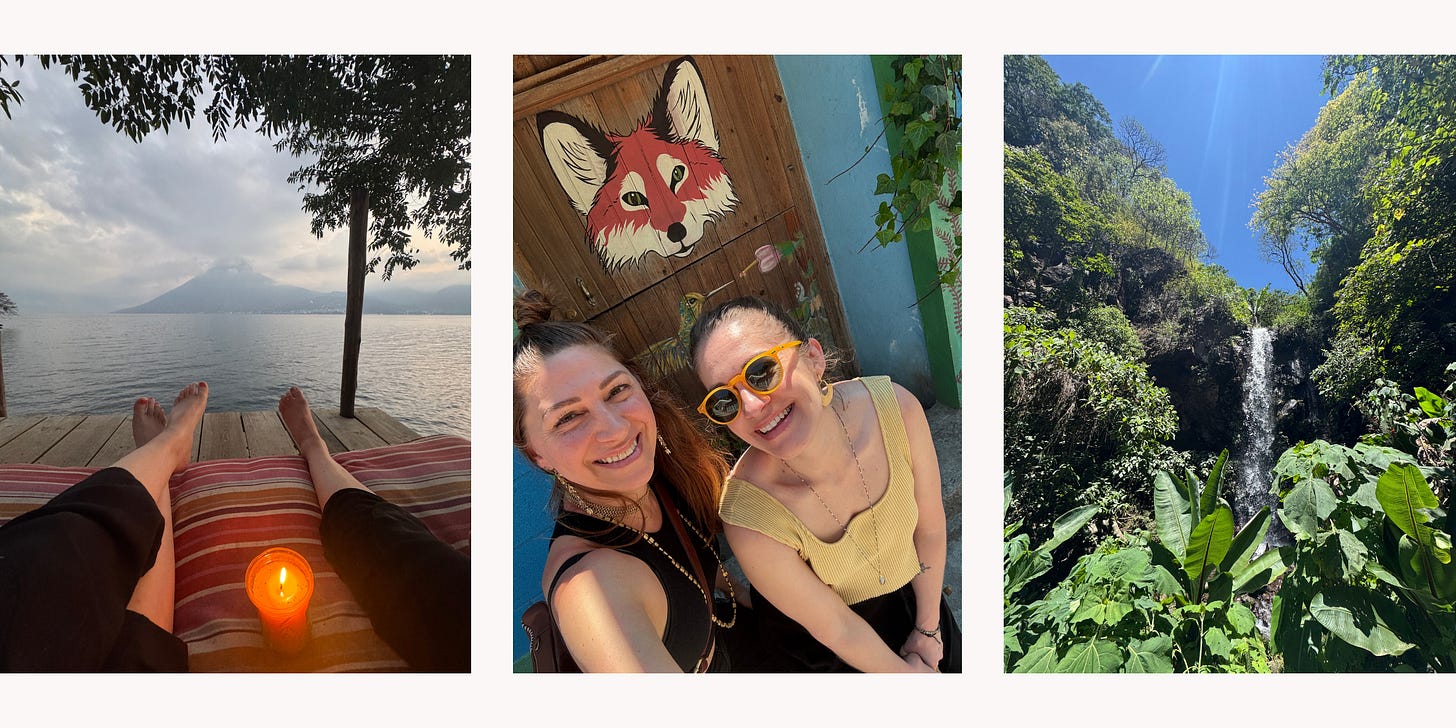
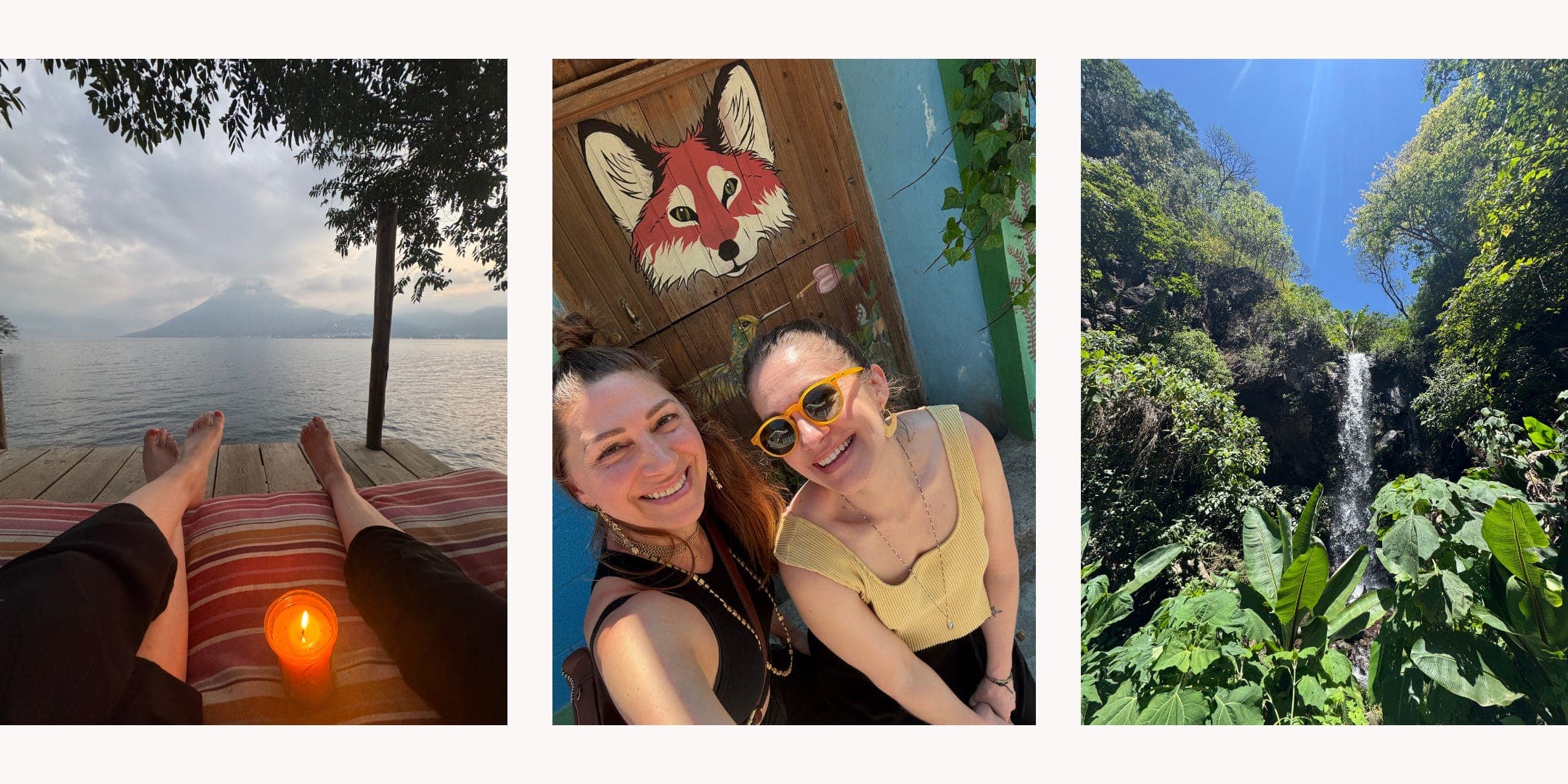
For my birthday in April, my girlfriend and I spent nearly two weeks exploring Antigua and Lake Atitlán.
The lake itself felt almost mythological. Three volcanoes rose from the water. Every afternoon strong winds called the Xocomil swept across the surface, rattling the trees and sending clouds drifting across the mountains. Mornings unfolded quietly. Coffee in hammocks. Bare feet against cool stone floors. Birds moving through the banana trees. Yoga mats rolled out side by side overlooking the lake. Some days we wandered textile markets. Other days we paddled canoes along the shoreline or hiked through the mountains to a waterfall with a local Mayan guide named Cheyo.
Something in me softened there.
Not all at once.
Gradually.
Like sediment settling after water has been disturbed.
My girlfriend had brought her flute, and some afternoons she would sit beside the lake and play while the wind carried the notes away. We cooked together in the outdoor kitchen. Harvested herbs from the gardens. One afternoon we joined a sweaty outdoor ecstatic dance party, moving barefoot alongside travelers from around the world as an incredible DJ spun beneath the trees. We laughed. We danced. We were wonderfully silly together. Around her, I kept meeting versions of myself that felt harder to access inside my ordinary life. More playful. Less defended. Less organized around responsibility and caretaking.
I had spent years thinking about relationships mostly in terms of compatibility or commitment.
Traveling with her made me wonder about something different.
Who do I become in her presence?
What parts of me come alive here?
What parts finally get to rest?
The trip felt expansive.
Part of what made it so meaningful was that I had spent the previous year getting honest about how much I wanted something like this.
The summer before, after my nesting partner traveled to Jamaica with his other partner, I wrote an essay about envy in polyamory. What I eventually realized was that beneath the envy lived a clear desire: a partner with enough spaciousness for adventure, quality time, and the kind of shared experiences that allow a relationship to deepen.
Naming that desire changed something.
It helped me stop focusing on what was missing and start paying attention to what I was genuinely seeking.
Now, less than a year later, I was bouncing across the lake in a boat and flying down dirt roads in tuk-tuks with a woman who had enthusiastically said yes to building this adventure with me.
In many ways, I was living inside the very thing my envy had been pointing toward.
Which made what happened next all the more surprising.
I froze in public in small, automatic ways. Reactions that were so immediate and familiar, they were almost imperceptible enough to miss at first.
Sometimes I’d reach instinctively for her hand while we were walking and stop halfway there. Sometimes I lowered my voice when conversations drifted toward intimacy. Sometimes I found myself scanning restaurants or public spaces before fully relaxing beside her.
Nothing had happened. Nobody had said anything. And yet I kept noticing these tiny moments of hesitation and faint calculations happening beneath conscious awareness. My body was behaving as though there was something to monitor before I could fully let my guard down.
At first I couldn’t understand it. I had been dating women for years by then. I wasn’t ashamed. I wasn’t confused. I wasn’t trying to hide. At least that’s what I thought.
Guatemala itself did not feel overtly unsafe, yet I kept trying to reason my way out of it. Maybe I was being cautious in an unfamiliar environment. Maybe I was overthinking things. Maybe I was imagining it.
Then it dawned on me that I’d grown accustomed to moving through environments like San Francisco and New York, where being queer rarely drew attention. My body noticed the difference the moment that changed.
The truth is, there’s a difference between being out and feeling safe. And there is also a difference between feeling safe and feeling free.
I think I had unconsciously mistaken the relative safety of the Bay Area for complete freedom.
But freedom is not just believing something intellectually. It’s the moment your body begins to trust what your mind already knows. The moment you stop constantly monitoring how others might respond or shrinking when your truth becomes visible.
Toward the end of the trip, my girlfriend and I became unexpectedly close with two other solo female travelers staying at our retreat center, one from Germany and the other from the UK. We hiked together, shared meals, listened to stories around the fire at night, and eventually participated together in a cacao ceremony and a traditional Mayan sweat lodge.
By the time we entered the Tuj, it felt as though we knew one another in a way that usually takes much longer.
The experience was beautiful. We prayed together. Sweated in the dark. Spoke about what we were releasing and what we hoped to call into our lives.
There is something about ritual that dissolves social distance.
For days, we had been slowly exchanging pieces of ourselves. Stories about divorce and reinvention. Family histories. Grief. Loneliness. Love. The ways life had surprised us. The ways it had broken us open.
We had cooked together, hiked together, laughed together, and sat in silence together.
The usual social scripts had softened.
By the end of the ceremony, these women no longer felt like strangers.
Which is why what happened next surprised me.
Wrapped in towels and still dripping from the cold plunge, one of the women looked at us and asked casually:
“So how do you two know each other, anyway?”
The question was innocent. But I felt my entire body hesitate. I opened my mouth. Nothing came out. It felt like there was so much to say, I didn’t even know where to begin.
My girlfriend glanced toward me and answered for us. “We’re dating.”
Both women looked genuinely surprised.
I felt myself tighten, waiting for their reaction.
“Oh!” one woman said with a laugh. “I had no idea:”
Then she smiled and added:
“You hid it well.”
A moment later she asked, gently:
“Did you mean to hide it?”
That question has stayed with me ever since. Because I didn’t know the answer. We hadn’t set out to hide anything. And yet I couldn’t dismiss the question.
I thought about the times I’d held back my affection. The assumptions I’d allowed people to make. The inconspicuous calculations happening beneath my awareness whenever visibility became a possibility.
None of it felt intentional, but it did feel familiar. Like an old reflex I hadn’t realized I was still carrying. In IFS language, I might call it a manager part—a protective aspect of myself that had learned long ago to monitor the environment, anticipate risk, and adjust accordingly.
This part had spent years trying to keep me safe, driven by care and a desire to prevent rejection before it happened. To assess the room before relaxing fully. To make sure it was safe before becoming visible because, somewhere along the way, living in a heteronormative society, it had learned that visibility sometimes carries consequences.
And to be fair, that lesson isn’t entirely wrong. For many queer people, caution is not pathology. It’s wisdom. There are still places in the world where visibility can come with real social, professional, familial, or physical risks.
What I was noticing wasn’t that this protective part existed. It was that it seemed to be operating automatically, even in moments when I wanted more choice.
The more I sat with it, the more compassion I felt. This wasn’t some flaw I needed to overcome. It was the lingering echo of an adaptation that had worked well enough to keep me safe in another time and place. An old protective measure that my body hadn’t fully realized could be consulted rather than obeyed automatically.
I suddenly found myself wanting to explain everything to our new international friends. That we had been moving fluidly between friendship and dating for more than a year before we settled into an official “girlfriends” label. That we both lived with men. That we were polyamorous. That this relationship was real even if it didn’t fit neatly into the categories people expected. That we were still learning the shape of what we were becoming together.
More than anything, I realized I wanted to be known. I just hadn’t realized how much of me was still waiting for permission or evidence that it was safe.
The irony, of course, is that the warmth of their acceptance and curiosity was immediate.
“How cool.”
Then questions.
Nothing terrible happened. No rejection. No judgment.
And yet that moment revealed something I hadn’t been able to see before.
The closet doesn’t always look like secrecy.
Sometimes it looks like self-protection. Sometimes it looks like waiting for proof that you’ll be accepted before revealing yourself. Sometimes it looks like letting people make assumptions because correcting them feels vulnerable. Sometimes it looks like quietly withholding the parts that feel most exposed.
What surprised me most was realizing that I had confused being out with being finished. In Guatemala, I realized there were still places where my body felt less free than my beliefs.
Not because I was ashamed. Not because I wanted to hide. But because visibility asks something different of us.
It asks us to be seen.
This Pride Month, I’m thinking less about the first time I came out and more about all the ways I’m still learning to.
The places where shame is gone but caution remains. The places where I feel proud in theory but hesitant in practice. The places where my nervous system still hasn’t fully caught up to what my heart already knows.
One of the things I love most about Pride Month is that it reminds me how many assumptions we absorb before we’re old enough to question them.
Many queer people grow up assuming they’re straight. Not because they’ve carefully examined every possibility. Because it’s the default. The water we’re swimming in.
Relationships often work the same way.
We inherit scripts about love, commitment, marriage, family, and belonging long before we’re old enough to decide whether they fit.
And for some of us, adulthood becomes the process of questioning those scripts.
Not just once. Again and again.
People often ask me whether queerness and polyamory are connected.
The answer is both yes and no.
No, because plenty of queer people are monogamous and plenty of polyamorous people are straight.
But yes, because both have asked me to practice the same thing: Trusting my own experience more than the stories I inherited about who I was supposed to be.
The courage to tolerate uncertainty. The courage to withstand misunderstanding. The courage to disappoint people who wish I had made different choices. The courage to keep moving toward what feels true even when there isn’t a clear map.
Maybe that’s what Pride celebrates.
Not certainty. Not arrival. Not the fantasy that one day we’ll finally be done becoming ourselves.
Maybe Pride is the willingness to keep stepping out of every closet we encounter.
The ones built by culture. The ones built by fear. The ones built by habit. The ones we’ve forgotten we’re still living inside.
And to trust that on the other side of visibility there may be exactly what I found beside that lake in Guatemala: Not rejection. Not judgment. Just the possibility of being known.
One of the quiet challenges of exploring non-monogamy is that many of us don’t have many places where we can talk openly about the questions we’re exploring, the challenges we’re facing, or who we’re becoming.
On July 6 at 5pm PST, I’m hosting a free online community meet & greet in honor of Pride Month and OPEN’s Week of Visibility for Non-Monogamy.
Whether you’re newly curious, actively practicing non-monogamy, queer, straight, questioning, partnered, solo, or somewhere in between, you’re welcome.
Come meet some thoughtful humans and feel a little less alone 🫶
If this resonated with you, I’d love to hear from you in the comments.
What part of yourself is still waiting for evidence that it’s safe to be seen?
Where do your beliefs and your nervous system still tell slightly different stories?
What truth about yourself feels easier to believe than to embody?
More on the intersection of queerness and non-monogamy:
Original Post: Aria Diana

Scan to download
Comments
Join the conversation — create a free account to comment.
Join the conversationLoading comments…