METAMOURS & STRUCTURES
Polyamory Isn’t a Pie — But Time Is Indeed Finite
A nervous-system-first reframe for scarcity, structure, and getting honest about what we need for secure non-monogamy
A nervous-system-first reframe for scarcity, structure, and getting honest about what we need for secure non-monogamy

I received this question from a client recently, and I wanted to share a longer response than I sent her, because I know she’s not alone in this struggle. I hear versions of this question all the time.
“Something that I am struggling to reconcile at the moment is the notion that polyamory is not a pie to be divided up, and that there is enough love to go around.
In reality, time and energy are finite resources. When my partner chooses to spend time and energy with one of his other people, it does mean that he has less time and energy for me.
Can you help me to reframe that?”
-Counting the Slices
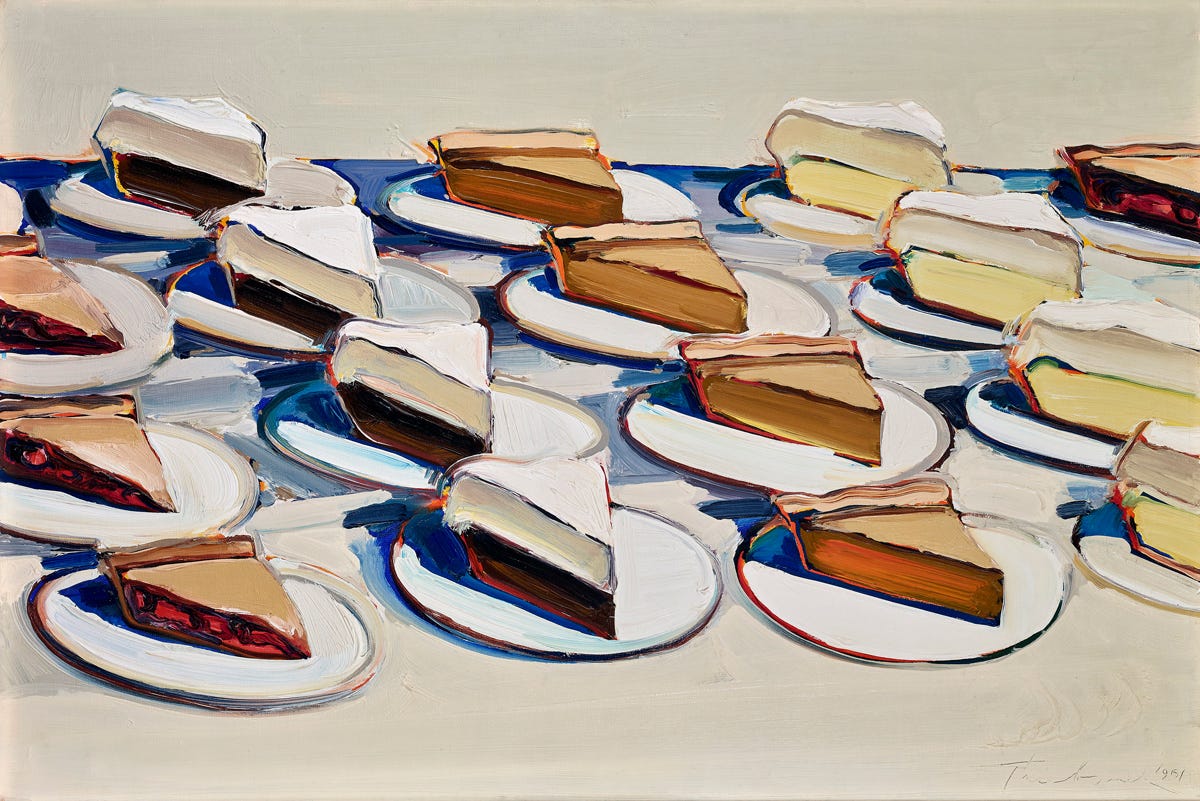
“Pies, Pies, Pies” by Wayne Thiebaud, 1961
Dear Counting the Slices,
Yes, and first, I want to say this clearly: What you’re noticing is true.
When your partner chooses to spend time or energy with someone else, he does have less of those resources available to you in that moment.
If we try to override the truth that time, energy and attention are finite with platitudes, something inside us usually protests.
Because the pain isn’t coming from a belief in scarcity, it’s coming from a felt experience of uncertainty, loss, or disconnection.
And that deserves to be honored, not argued with.
Your “Math” Is Right, But Here’s the Part That Gets Missed
Where the reframe becomes helpful isn’t in denying that reality, but in separating logistical limits from relational meaning.
What’s not a fixed pie:
the meaning of connection
the depth of care
the possibility of intimacy
What is limited:
hours in a day
emotional bandwidth
nervous-system capacity
how many relationships can be tended well at one time
So the real question isn’t:
“Is there enough love to go around?”
It’s:
“Do I feel securely held within the time and energy that is available to me?”
That’s a very different inquiry. Let’s explore it.
Where the “Pie” Metaphor Breaks Down
When people say “love isn’t a pie,” they’re trying to counter a real fear:
that more for someone else automatically means less for you.
And on a conceptual level, that’s true. Love doesn’t get used up just because it’s shared. Most of us already understand this in at least one mainstream, culturally accepted context: When parents have a second child, it doesn’t mean their love for their first-born diminishes. Care expands.
But the pie metaphor collapses love and capacity into the same thing…and they’re not the same. That’s where it stops being helpful.
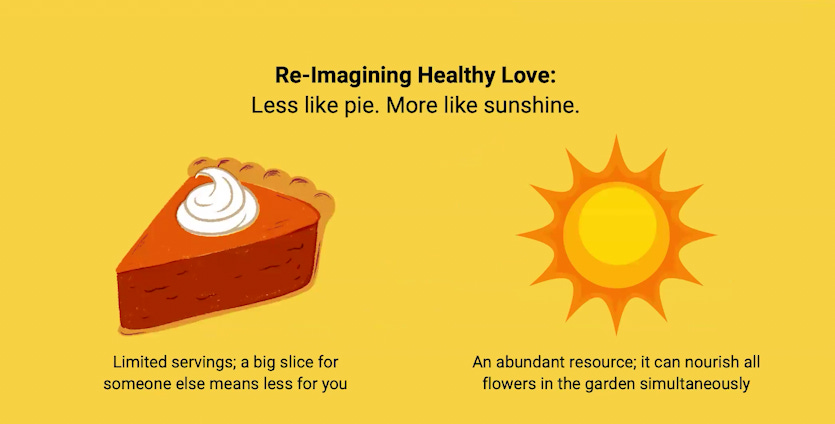
So instead of imagining love as pie when it comes to polyamory, I often invite people to imagine love as sunshine.
Sunshine isn’t divided when it warms more than one body. It doesn’t weaken because it shines elsewhere. It can nourish many flowers in the same garden at the same time.
Sunshine doesn’t disappear when it shines elsewhere. But we still need windows, schedules, rituals, and seasons so our bodies know when and where to anticipate and enjoy the warmth.
Love May Be Abundant But Access Is Contextual
Here’s the reframe that usually lands more honestly:
Love isn’t scarce. But access to connection is shaped by time, rhythm, and reliability.
A plant in the shade doesn’t need to be told, “The sun exists somewhere.”
It needs to know when the light is coming back.
Most scarcity feelings in non-monogamy aren’t actually about love disappearing.
They’re about uncertainty.
When will I see you again?
Do I still matter when I’m not the focus?
Can I trust repair and return?
Is there a rhythm I can orient to?
When those answers are fuzzy, the nervous system does exactly what it’s designed to do: it sounds an alarm.
That alarm isn’t saying, “There’s not enough love.”
It’s saying, “I don’t know where I land.”
That’s a relational clarity issue (and it’s one that can actually be addressed).
When Scarcity Is Really About Needs and Agency
When someone says, “It feels like there’s not enough to go around,” they’re rarely talking about love in the abstract.
They’re usually pointing to something more specific, like:
not knowing when they’ll get time again
not feeling actively chosen or anticipated
plans changing without attunement
lack of reassurance after time apart
no shared schedule or ritual to anchor the connection
Scarcity doesn’t always mean something is missing. Often, it means something feels out of your control. Scarcity is a bodily experience, with a texture: tightness, urgency, comparison, bracing, the impulse to rush or measure love like currency.
The goal isn’t to eliminate fear, doubt, or scarcity. The goal is to recognize when those energies are present, and not let them drive your decisions.
This doesn’t mean we need to be fear-free to be non-monogamous, but we do need to be able to slow down enough and say:
Ah. This is the scarcity voice that is trying to compare my value to someone else. Instead of falling into that story, I’m going to self-soothe, co-regulate, and get clear about what I actually need (here’s a list of needs that might help you articulate what that is).
This Is Often an Invitation to Get Specific
When scarcity shows up, it’s usually not asking you to think differently.
It’s asking you to get more specific.
Often the real questions sound like:
What helps me feel chosen even when we’re apart?
What kind of predictability calms my body?
How do we reconnect after time with others?
What reassurance helps me not spiral into comparison?
What rhythms, rituals, or agreements create continuity for me?
How do I stay emotionally tethered, even when I’m not the focus?
These aren’t demands. They’re orienting questions. They help finite time become secure time.
They’re how sunshine becomes something your body can actually feel, not just believe in. Not a concept, a lived experience.

Van Gogh, 1889
Original Post: Aria Diana

Scan to download
Comments
Join the conversation — create a free account to comment.
Join the conversationLoading comments…