MIND & BODY
Part 2: Why the Need for Space Can Intensify Fears of Abandonment
Exploring the other side of the safety–freedom tension in non-monogamy: the partner who moves toward space when fear activates
Exploring the other side of the safety–freedom tension in non-monogamy: the partner who moves toward space when fear activates
The Week of Visibility for Non-Monogamy returns next month! On Monday, July 6th, I’m hosting a free community gathering to connect, reflect, and be in conversation with other relationship explorers walking similar paths.
In Part 1 of this series, I explored the experience of the partner who reaches for closeness when fear activates. This time, we return to the exact same conversation from the perspective of the partner who reaches for space when emotional intensity rises.
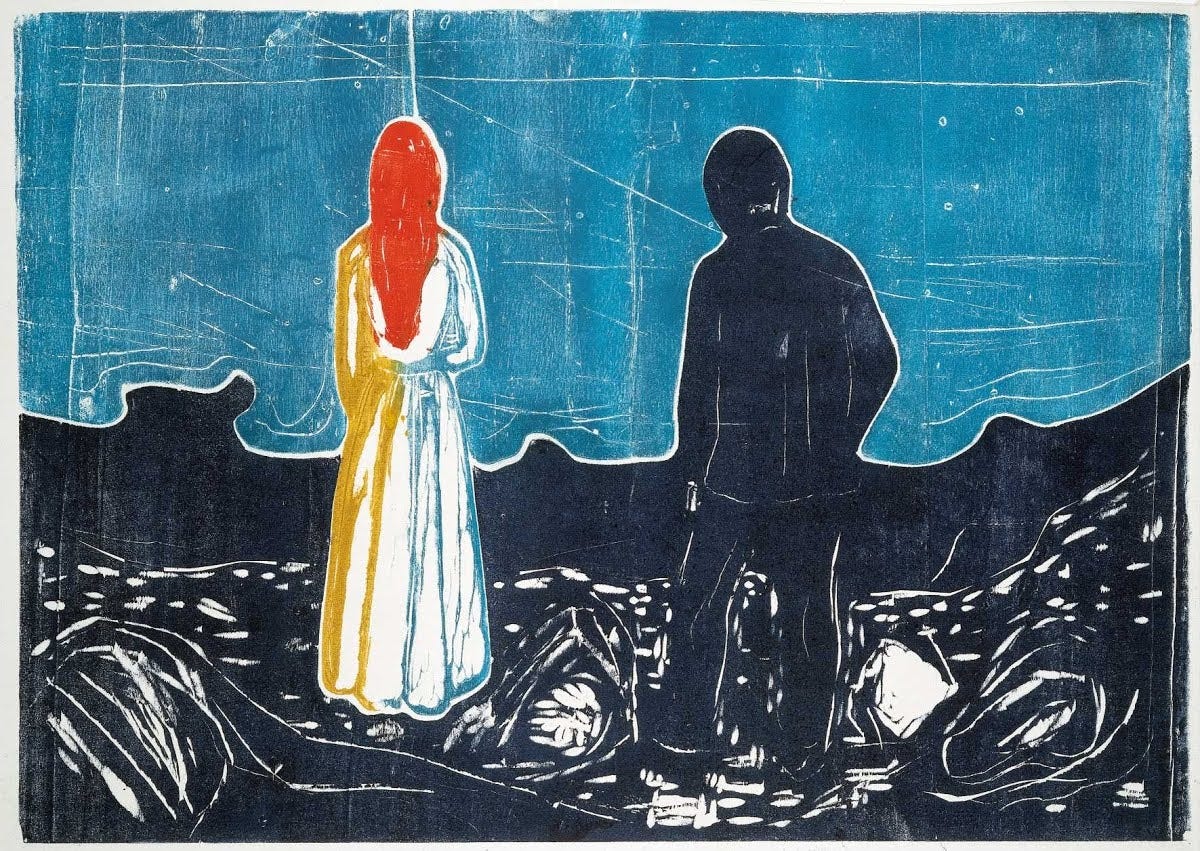
Two People: The Lonely Ones, Edvard Munch, 1899
Jules had been excited about the upcoming second date until Micah started crying. Almost immediately, Jules felt the excitement leave their body. Their chest tightened. Their eyes moved toward the door.
The date no longer felt exciting. It felt expensive.
Suddenly, Jules wasn’t thinking about what they wanted anymore.
How hurt was Micah? How much reassurance would he need? Would this become another long conversation? Would they eventually decide the date wasn’t worth the impact it was having? Would wanting more relational freedom always come with this much pain?
Their attention shifted almost immediately away from desire and toward impact—anticipating consequences, managing Micah’s emotional experience, and figuring out what wanting more freedom might now cost.
And beneath all of that, Jules began to feel the growing fear that they didn’t know if it was possible to have the life and open relationship they wanted without hurting the person they love most.
One of the biggest misunderstandings I see in open relationships is the assumption that the person who pulls back when their partner becomes distressed cares less or is somehow less affected by what’s happening.
In reality, many people who instinctively need space when big feelings arise—like Jules did when Micah had a painful reaction to the disclosure—care deeply about their relationships. They value intimacy, commitment, and emotional closeness just as much as their partners do. What they struggle with is staying connected to someone else’s pain while remaining connected to themselves.
Sometimes what gets labeled as emotional unavailability is actually profound overwhelm in the presence of another person’s distress.
For some people, needing space became an important survival strategy long before they ever opened a relationship. Perhaps other people’s emotions consistently took over the room. Perhaps conflict felt inescapable. Perhaps closeness became associated with responsibility, obligation, or losing access to their own internal experience.
Over time, someone else’s pain may have come to feel like something that needed to be managed, fixed, or escaped rather than simply witnessed.
Seen through this lens, taking space is often less about avoiding connection and more about trying to preserve a connection to oneself.
Needing space is not the same thing as being avoidant. Wanting room for your own desires does not make you selfish. And caring deeply about someone else’s pain does not mean you are responsible for making it disappear.
In relationships where one person’s safety strategy is closeness, the other person can sometimes begin to feel as though there is less and less room for their own desires because so much energy becomes devoted to helping their partner feel emotionally secure.
Many people who love deeply but become overwhelmed by emotional intensity find themselves spending hours processing conversations, explaining their intentions, clarifying what they meant, offering reassurance, softening impact, anticipating reactions before they happen, or carefully filtering how they share their desires in order to avoid creating more distress. And while much of this behavior comes from genuine care, after a while, something subtle can begin to happen.
The internal question gradually changes from:
What do I want?
to:
What will create the least amount of disruption?
One of the paradoxes of non-monogamy is that people often open a relationship in pursuit of greater freedom, only to discover that they are spending more and more of their energy managing the impact that freedom has on someone they love.
Will this lead to another difficult conversation?
Will it create more anxiety?
Will someone end up feeling hurt, rejected, or destabilized?
And eventually:
Is it even worth bringing up?
Especially in the early stages of opening a relationship, when nervous system activation is high, many people begin bringing less and less of themselves forward. They stop sharing certain desires, curiosities, hopes, or possibilities—not because those parts disappear, but because each new desire begins to feel like it carries an emotional price tag.
One of the most painful ironies in non-monogamy is that the very strategies people use to create safety can unintentionally intensify their partner’s deepest fear.
The person who fears abandonment often reaches for more closeness in order to restore connection. They want reassurance that they are still chosen, still important, still securely held inside the relationship even as their partner’s world expands.
The person who fears losing themselves often reaches for more space in order to restore freedom and reconnect with their own internal experience.
And without realizing it, both people can end up creating exactly what the other person fears most.
The more urgently one person reaches for closeness, reassurance, certainty, or emotional contact, the more pressure their partner may begin to experience.
The more the other person withdraws in an attempt to find room to breathe, the more alone and emotionally untethered their partner can feel.
And so the cycle intensifies.
Original Post: Aria Diana

Scan to download
Comments
Join the conversation — create a free account to comment.
Join the conversationLoading comments…